Overview
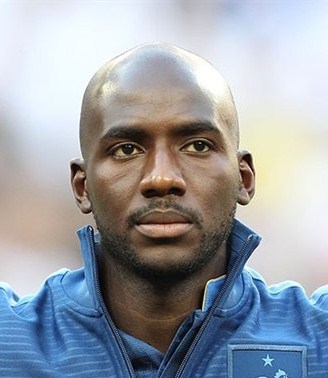
Alou Diarra, born on July 15, 1981, in Villepinte, France, is a former professional footballer who carved out a distinguished career primarily as a defensive midfielder. Standing at 1.90 meters, Diarra was renowned for his imposing physical stature, which he effectively leveraged to dominate the midfield battleground. His career trajectory saw him play for several prominent clubs across France and England, establishing a reputation as a robust, disciplined, and influential presence in the center of the park. Diarra also earned significant recognition on the international stage, representing the French national team across multiple major tournaments, including FIFA World Cups and UEFA European Championships. His journey from the youth ranks to the pinnacle of professional football underscores a career built on resilience and consistent performance.
Position
Throughout his career, Alou Diarra predominantly operated as a defensive midfielder. This role demanded a combination of physical strength, tactical awareness, and the ability to break up opposition attacks. Diarra excelled in shielding the defense, recovering possession, and initiating offensive plays with simple, effective passing. He occasionally featured as a central midfielder in a box-to-box capacity, showcasing his versatility, but his most impactful performances consistently came from the deeper midfield role where his defensive attributes shone brightest.
Identity
Alou Diarra's footballing identity can be encapsulated as a 'commanding midfield anchor.' He was a player who brought stability and steel to any team he represented. His leadership qualities, often demonstrated through his unwavering commitment and vocal presence, were highly valued by coaches and teammates alike. Diarra was not known for flamboyant skills or prolific goalscoring, but rather for his consistent effort, tactical discipline, and ability to dictate the tempo of a game from a deep-lying position. His career is a testament to the importance of a strong, reliable defensive presence in modern football.
Career path
Alou Diarra's professional career began after spells in various youth academies, ultimately leading him to the esteemed CS Sedan Ardennes youth system. He made his senior debut with Sedan, quickly attracting attention before a move to German giants Bayern Munich in 2000. However, Diarra struggled to break into the first team at Bayern, spending time with the reserve squad before returning to France to join Liverpool FC in 2002. His time at Anfield was also marked by a lack of first-team opportunities, leading to a series of loan spells that would shape the early part of his senior career.
Loan Spells and Breakthrough at Lens
After joining Liverpool, Diarra was immediately loaned out to Le Havre AC for the 2002–03 season, where he gained valuable first-team experience. He then moved to SC Bastia on a season-long loan for the 2003–04 campaign. These experiences allowed him to hone his skills and adapt to the demands of professional football. His performances caught the eye of RC Lens, who signed him permanently in 2004 from Liverpool. It was at Lens that Diarra truly established himself, becoming a pivotal player and a regular starter for two successful seasons. His strong displays earned him a move to French powerhouse Olympique Lyonnais in 2006, as documented by Transfermarkt.
Olympique Lyonnais and Bordeaux Success
At Olympique Lyonnais, Diarra was part of a dominant squad that clinched the Ligue 1 title in the 2006–07 season. Despite the team's success, he spent only one season with Lyon before moving to fellow Ligue 1 side Girondins de Bordeaux in 2007. It was at Bordeaux where Diarra enjoyed some of the most successful years of his career, becoming captain and leading the club to a memorable Ligue 1 title in the 2008–09 season, along with two Coupe de la Ligue trophies and two Trophée des Champions. His leadership and consistent performances made him an icon at the club, as noted by Wikipedia's account of his club career. After four successful seasons, he departed Bordeaux for Olympique Marseille in 2011.
Later Career and Retirement
Diarra's tenure at Olympique Marseille was relatively short, lasting just one season before he moved to England to join West Ham United in 2012. He subsequently had spells with Stade Rennais, Charlton Athletic, and was last seen playing for AS Nancy Lorraine in 2016–17, after which he retired from professional football. His career saw him represent several major European clubs, showcasing his adaptability and consistent quality across different leagues.
Playing style
Alou Diarra's playing style was characterized by his robust physicality, tactical intelligence, and disciplined approach to the defensive midfield role. Standing at 1.90m, he possessed an imposing frame that made him incredibly effective in aerial duels and physical contests in the center of the pitch. This allowed him to dominate opposition midfielders, breaking up attacks and winning back possession for his team. His ability to read the game was a key attribute, enabling him to anticipate passes and position himself effectively to intercept balls or cover defensive spaces.
Diarra was not a player known for intricate dribbling or creative passing, but rather for his efficiency and pragmatism. His distribution was typically simple, focusing on short, accurate passes to retain possession and recycle the ball, allowing more technically gifted teammates to initiate offensive movements. This reliability made him a crucial component in possession-based systems, offering a secure base from which attacks could be built. Data from platforms like FBref often highlighted his high volume of tackles and interceptions, underscoring his primary function as a ball-winner and destroyer of opposition play.
Defensive work rate was another hallmark of Diarra's game. He was tireless in his efforts to press opponents, track back, and provide defensive cover. This commitment extended to his leadership on the field, often organizing the midfield and defense through vocal commands. While not prolific in goal contributions, his value lay in his ability to provide a strong defensive shield, allowing attacking players more freedom. In terms of comparable players, his style echoed that of other physically strong, defensively astute midfielders such as Patrick Vieira during his later career phases, or perhaps even a more defensively focused Nemanja Matić, both known for their ability to control the midfield through presence and tactical discipline.
Achievements & honours
Alou Diarra enjoyed a successful professional career, accumulating several significant team honours across his time in French football. His most decorated period came during his tenure with Girondins de Bordeaux, where he was a central figure in a highly successful era for the club. Diarra's leadership and consistent performances were instrumental in securing these titles.
His achievements include:
| Club | Competition | Year(s) |
|---|---|---|
| Olympique Lyonnais | Ligue 1 | 2006–07 |
| Girondins de Bordeaux | Ligue 1 | 2008–09 |
| Girondins de Bordeaux | Coupe de la Ligue | 2008–09 |
| Girondins de Bordeaux | Trophée des Champions | 2008, 2009 |
Beyond these club accolades, Diarra also played a significant role in the French national team, participating in major tournaments, which is an achievement in itself for any professional footballer.
International career
Alou Diarra's international career with the French national team spanned several years, seeing him earn 44 caps for his country. He made his debut for Les Bleus in October 2004, and his consistent performances at club level ensured his regular inclusion in the national squad for much of the late 2000s and early 2010s. Diarra was a reliable presence in midfield, often deployed as a defensive anchor, providing steel and tactical discipline.
He represented France in several major international tournaments. Diarra was part of the squad that reached the final of the 2006 FIFA World Cup in Germany, an experience that showcased his potential on the biggest stage, as detailed by FIFA's World Cup archives. Although he did not feature prominently in the knockout stages of that tournament, his presence in the squad was a testament to his rising profile.
Diarra also featured in the 2010 FIFA World Cup in South Africa, where he played a more substantial role, starting in all three of France's group stage matches. Despite France's disappointing early exit from the tournament, Diarra's performances were characterized by his usual combative style and commitment. His final major tournament appearance came at UEFA Euro 2012, where he featured in two group stage matches as France reached the quarter-finals, ultimately losing to eventual champions Spain. Throughout his international career, Diarra never scored a goal for France, but his value lay in his defensive contributions and leadership in the midfield. He consistently provided a stable and experienced option for various national team managers.
What makes Alou Diarra stand out
Alou Diarra stood out primarily due to his exceptional physical presence and his unwavering commitment to the defensive side of the game. In an era where midfield play often prioritizes technical flair, Diarra carved a niche as a genuine 'destroyer,' capable of breaking up opposition attacks with regularity. His height and strength made him formidable in aerial duels, winning many crucial headers across his career, and his relentless work rate ensured he was always involved in the heart of the midfield battle. Beyond his physical attributes, Diarra possessed a strong tactical understanding, allowing him to position himself effectively and read the game to intercept passes and cover teammates.
Another distinguishing trait was his leadership. Diarra frequently captained his clubs, most notably during his successful spell at Girondins de Bordeaux, where he lifted the Ligue 1 title. His leadership was not just about wearing the armband; it was evident in his organizational skills on the pitch and his ability to rally his teammates, even in challenging circumstances. He was a vocal presence, guiding those around him and setting a high standard through his own consistent effort.
"Alou was a warrior in midfield. He gave everything for the team, every single game." – Laurent Blanc, former coach at Bordeaux and France.