Overview
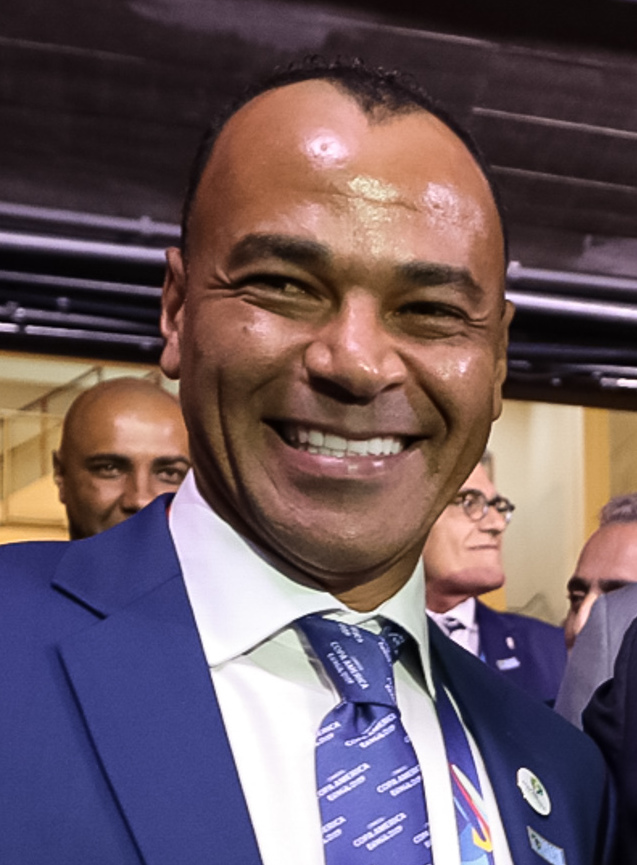
Marcos Evangelista de Moraes, universally known as Cafu, is a legendary Brazilian footballer who redefined the role of the attacking right-back. Born on June 7, 1970, in Itaquaquecetuba, Brazil, Cafu's career spanned from 1989 to 2008, during which he achieved unparalleled success at both club and international levels. He is celebrated for his relentless energy, exceptional stamina, and remarkable ability to contribute significantly in both defense and attack.
Position
Cafu primarily operated as a right-back, a position he revolutionized with his offensive prowess. While fulfilling his defensive duties with diligence, his natural inclination was to surge forward, providing width, delivering crosses, and often joining the attack in central areas. His versatility also allowed him to play as a right-sided midfielder or wing-back when tactical setups demanded, showcasing his adaptive football intelligence.
Identity
Known as 'O Pendolino' (The Express Train) for his tireless runs up and down the flank, Cafu embodied the modern full-back long before the role became a staple of top-tier European football. His headline identity is that of an indefatigable, two-way full-back whose leadership and winning mentality were as impactful as his technical skills. He captained Brazil to their fifth FIFA World Cup title in 2002, a testament to his influence and stature within the squad. His legacy is firmly etched as one of the most iconic and successful defenders in football history.
Career path
Cafu's illustrious career began in Brazil before he embarked on a highly successful journey through European football, leaving an indelible mark at every club.
São Paulo (1989–1994)
Cafu began his professional career with São Paulo FC in 1989. Under the tutelage of manager Telê Santana, he quickly established himself as a key player in a golden era for the club. He was part of the São Paulo squad that won consecutive Copa Libertadores titles in 1992 and 1993, and back-to-back Intercontinental Cups in the same years. His performances at São Paulo drew international attention, particularly for his attacking runs from deep positions [Transfermarkt].
Real Zaragoza (1994–1995)
Following his success in Brazil, Cafu moved to Europe, joining Spanish club Real Zaragoza in 1994. Although his tenure was brief, lasting just one season, he made a significant impact. He helped Zaragoza win the UEFA Cup Winners' Cup in 1995, defeating Arsenal in the final. This experience provided him with his first taste of European club success [Wikipedia].
Palmeiras (1996)
After his short stint in Spain, Cafu returned to Brazil, playing for Palmeiras for a single season in 1996. His return was met with enthusiasm, and he continued to showcase his high level of performance, further solidifying his reputation within Brazilian football before his next move to Europe.
Roma (1997–2003)
In 1997, Cafu made a significant move to Italy, signing with AS Roma. It was in Rome that he truly cemented his status as one of the world's premier right-backs. Over six seasons, he became a fan favorite, known for his attacking flair and relentless work rate. He played a pivotal role in Roma's Serie A title triumph in the 2000–01 season, their first Scudetto in 18 years. During his time at Roma, he earned the nickname 'Il Pendolino' [Transfermarkt].
AC Milan (2003–2008)
At the age of 33, Cafu joined AC Milan in 2003, a move that surprised many due to his age. However, he defied expectations, enjoying another highly successful period of his career. He quickly integrated into Milan's star-studded squad, winning the Serie A title in his first season (2003–04). The pinnacle of his club career came in 2007 when he lifted the UEFA Champions League trophy with Milan, defeating Liverpool in the final. He retired from professional football in 2008 after five seasons with the Rossoneri [UEFA Champions League].
Playing style
Cafu's playing style was characterized by an extraordinary blend of technical skill, athletic endurance, and tactical intelligence, making him the prototype of the modern attacking full-back. His ability to influence both ends of the pitch was a defining feature of his game.
Attacking Prowess
As a right-back, Cafu was renowned for his incessant forward runs down the flank. His pace and stamina allowed him to consistently overlap wingers, creating numerical advantages and delivering dangerous crosses into the box. He possessed excellent dribbling skills, enabling him to beat defenders in one-on-one situations and drive into advanced positions. His attacking contributions were not limited to crossing; he also had a keen eye for a pass and was capable of scoring crucial goals, often arriving late in the box to convert chances. His style was comparable to later generations of attacking full-backs like Dani Alves or Achraf Hakimi, albeit with a more rugged defensive foundation.
Defensive Solidity
Despite his attacking inclinations, Cafu was a highly competent defender. He possessed strong tackling ability, good positional sense, and the speed to recover and track back. He was rarely caught out of position, thanks to his exceptional fitness levels and understanding of the game. His defensive work rate was exemplary, often seen battling for possession deep in his own half before launching another attack. This balance between offensive flair and defensive responsibility was a hallmark of his game, allowing him to be effective against a wide range of opponents.
Leadership and Stamina
Beyond his technical and physical attributes, Cafu was a natural leader on the pitch. His presence inspired confidence in his teammates, and his tireless efforts set a high standard. His stamina was legendary; he could maintain a high intensity for the entire 90 minutes, often making lung-bursting runs in the dying stages of a match. This combination of skill, athleticism, and leadership made him an invaluable asset to every team he represented, contributing to numerous trophy successes throughout his career.
Achievements & honours
Cafu's career is decorated with numerous team and individual accolades, highlighting his status as one of football's most successful players. His trophy cabinet reflects consistent success at the highest levels of club and international football.
Internationally, he is most celebrated for his two FIFA World Cup triumphs with Brazil, first in 1994 and then as captain in 2002. He also holds the unique record of being the only player to feature in three consecutive World Cup finals (1994, 1998, 2002) [FIFA World Cup]. At club level, he won league titles in Brazil and Italy, alongside major European competitions.
Team Honours
| Competition | Club | Year(s) |
|---|---|---|
| FIFA World Cup | Brazil | 1994, 2002 |
| Copa América | Brazil | 1997, 1999 |
| Copa Libertadores | São Paulo | 1992, 1993 |
| Intercontinental Cup | São Paulo | 1992, 1993 |
| UEFA Cup Winners' Cup | Real Zaragoza | 1995 |
| Serie A | Roma | 2000–01 |
| Serie A | AC Milan | 2003–04 |
| UEFA Champions League | AC Milan | 2006–07 |
| FIFA Club World Cup | AC Milan | 2007 |
International career
Cafu's international career with Brazil is among the most distinguished in football history. He made his debut for the Seleção in 1990 and went on to earn a record 142 caps, making him Brazil's most capped player [FIFA]. Throughout his 16-year international career, he scored 5 goals.
His involvement in the FIFA World Cup is particularly noteworthy. Cafu participated in four World Cup tournaments (1994, 1998, 2002, 2006), reaching the final in three consecutive editions – 1994, 1998, and 2002. He lifted the coveted trophy twice, first in 1994 as a substitute in the final against Italy, and then famously as captain in 2002, leading Brazil to victory over Germany in Yokohama, Japan [FIFA World Cup]. His iconic image holding the World Cup aloft became one of the defining moments of the tournament.
Beyond the World Cup, Cafu was also a key figure in Brazil's Copa América successes, winning the tournament in 1997 and 1999. His consistent performances, leadership, and unwavering commitment to the national team made him an indispensable player for various Brazilian coaches over more than a decade. His record number of caps underscores his longevity and enduring quality at the highest level of international football.
What makes Cafu stand out
Cafu stands out for several reasons, primarily his pioneering role in defining the modern attacking full-back and his remarkable longevity at the elite level. His unparalleled stamina allowed him to cover the entire right flank for 90 minutes, providing both defensive cover and a constant offensive threat. He combined raw athleticism with refined technical skills, making him a complete player for his position.
Another standout trait was his leadership. As captain of the 2002 World Cup-winning Brazil side, he demonstrated not only tactical acumen but also the ability to inspire and motivate his teammates, famously lifting the trophy with an iconic gesture. His ability to perform at the highest level well into his late 30s, culminating in a Champions League title with AC Milan at 37, further distinguishes him.
"Cafu was a phenomenon. He played with an energy and passion that was infectious, and he changed the way we think about the full-back role."