Overview
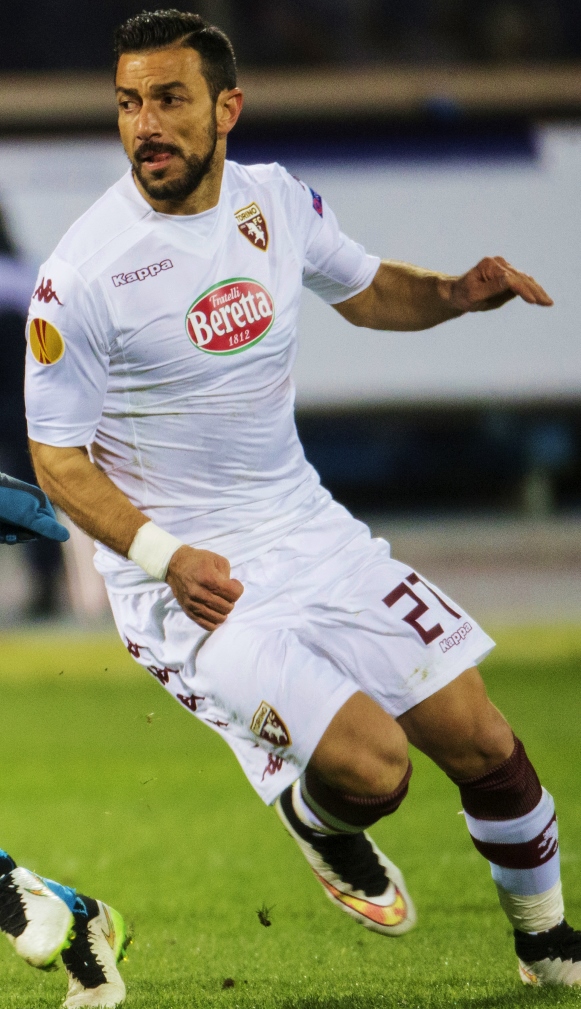
Fabio Quagliarella, born on January 31, 1983, in Castellammare di Stabia, Italy, is a professional footballer who has forged a notable career as a forward. Standing at 1.80 meters, Quagliarella is right-footed and has been recognized for his diverse goal-scoring ability, often from spectacular distances and angles. His career has been predominantly spent in Italy's Serie A, where he has become one of the league's most consistent and respected attackers across multiple generations of players.
Position
Quagliarella primarily operates as a central forward or a secondary striker. Throughout his career, he has demonstrated versatility, capable of leading the line as a lone striker, playing in a front two, or even drifting wide from a central position. His tactical intelligence allows him to find pockets of space and link up with midfielders, while his finishing instincts are geared towards being in the right place at the right time in the penalty area. He is also known for his ability to strike from outside the box, adding another dimension to his attacking threat.
Identity
Fabio Quagliarella's footballing identity is defined by his prolific goal-scoring, particularly his penchant for acrobatic volleys and powerful long-range shots. He is often described as a 'poacher with flair,' combining the predatory instincts of a traditional number nine with the technical ability to execute audacious finishes. His longevity at the highest level of Italian football, maintaining a high goal output well into his late thirties, underscores his dedication, physical conditioning, and enduring quality. He is renowned for scoring aesthetically pleasing goals that often feature in season highlights reels, earning him a reputation as a scorer of 'golazo'.
Career path
Fabio Quagliarella's extensive career began in the youth ranks of his hometown club, Torino FC, making his senior debut for the club in 2000. His early years involved several loan spells to gain experience, including moves to Fiorentina (then Florentia Viola) and Chieti, before returning to Torino. His breakthrough season came with Ascoli in Serie B during the 2004–05 campaign, where his performances attracted wider attention.
Early Career & Udinese
After a successful spell with Sampdoria, Quagliarella moved to Udinese Calcio in 2007, where he truly established himself as a top-tier Serie A forward. At Udinese, he scored 25 goals in 73 appearances across all competitions over two seasons, including an impressive 13 league goals in the 2008–09 season which earned him a transfer to Napoli. Transfermarkt records indicate his move to Napoli occurred in 2009 for a reported fee.
Napoli, Juventus & Return to Torino
His tenure at his hometown club SSC Napoli was relatively short but impactful, scoring 11 league goals in his debut season. However, he moved to Juventus in 2010, initially on loan, before making the deal permanent. At Juventus, Quagliarella won three consecutive Serie A titles from 2011–12 to 2013–14, contributing significantly with his goal-scoring and overall attacking play. Despite facing competition from other prominent strikers, he consistently found the net, registering 23 goals in 84 league appearances for the Turin giants. Following his time at Juventus, he returned to Torino for a second spell in 2014, where he continued his consistent goal-scoring form.
Sampdoria & Longevity
In 2016, Quagliarella joined Sampdoria, a club where he would spend a significant and highly productive period of his career. Here, he experienced a remarkable resurgence, particularly during the 2018–19 season where he finished as the Capocannoniere (Serie A top scorer) at the age of 36, netting 26 goals in 37 league appearances. This achievement made him one of the oldest players to win the award in Serie A history, a testament to his enduring quality and professionalism. He continued to be a vital player and captain for Sampdoria for several more seasons, consistently reaching double figures in league goals. His career journey, marked by numerous club changes and sustained performance, highlights his adaptability and offensive prowess.
Playing style
Fabio Quagliarella's playing style is characterized by a blend of technical skill, opportunistic finishing, and an exceptional ability to score from various situations. As a forward, his primary role is to find the back of the net, and he performs this with remarkable consistency.
Technical Attributes
Quagliarella possesses a powerful and accurate shot with his right foot, making him a threat from both inside and outside the penalty area. His capacity to strike the ball cleanly with minimal backlift allows him to surprise goalkeepers. He is particularly renowned for his volleys and half-volleys, showcasing excellent coordination and timing. His first touch is generally reliable, enabling him to control difficult passes and set himself up for shots or link-up play. While not a primary dribbler, he can hold up the ball effectively and release teammates into space.
Goal-scoring Instincts
His goal-scoring instincts are highly developed. Quagliarella demonstrates intelligent movement off the ball, often finding space between defenders or making well-timed runs into the box. He has a knack for anticipating deflections and rebounds, positioning himself for tap-ins, but he is equally capable of creating individual moments of brilliance. His goals often include spectacular overhead kicks, bicycle kicks, and long-range efforts, which have become a trademark of his career. For instance, in his Capocannoniere season, FBref stats show his non-penalty xG per 90 minutes remained competitive for a top striker, underlining his ability to get into dangerous positions.
Comparison and Influence
Quagliarella's style has drawn comparisons to classic Italian forwards known for their technical finishing and opportunistic nature, such as a more acrobatic Vincenzo Montella or a less physically dominant Christian Vieri in terms of pure striking. His longevity and ability to adapt his game as he aged also echo players like Francesco Totti, who maintained high performance levels into their late careers. His contributions extend beyond goals; he often provides assists through clever passes or flick-ons, demonstrating good vision in the final third. His work rate, while not always the highest in terms of pressing, is focused on offensive efficiency and making crucial runs.
Achievements & honours
Fabio Quagliarella has accumulated several significant achievements and honours throughout his extensive club career, notably excelling in Serie A.
Club Honours
| Competition | Club | Year(s) |
|---|---|---|
| Serie A | Juventus | 2011–12 |
| Serie A | Juventus | 2012–13 |
| Serie A | Juventus | 2013–14 |
| Supercoppa Italiana | Juventus | 2012 |
| Supercoppa Italiana | Juventus | 2013 |
| Serie C1 | Torino | 2000–01 |
Individual Accolades and Records
Quagliarella's most notable individual achievement came during the 2018–19 Serie A season, where he was crowned the Capocannoniere, the league's top scorer, with 26 goals for Sampdoria. This feat made him the oldest player to win the award since Dario Hübner in 2001–02. During the same season, he also set a record by scoring in 11 consecutive Serie A matches, equalling Gabriel Batistuta's record from the 1994–95 season. His performances earned him the Serie A Best Forward award for the 2018–19 season and he was included in the Serie A Team of the Year for the same period. These accolades highlight his remarkable consistency and goal-scoring prowess, particularly later in his career.
International career
Fabio Quagliarella represented the Italy national team at various levels, making his senior debut in 2007. He earned 28 caps for the Azzurri, scoring 9 goals during his international career.
Early Appearances and Major Tournaments
Quagliarella's senior international debut came on June 6, 2007, in a UEFA Euro 2008 qualifier against Lithuania, under then-coach Roberto Donadoni. He quickly made an impact, scoring his first two international goals in a Euro 2008 qualifier against Scotland later that year. He was part of Italy's squad for the UEFA Euro 2008 tournament, where Italy reached the quarter-finals. He was also selected for the 2010 FIFA World Cup in South Africa. During the group stage match against Slovakia, Quagliarella scored a memorable long-range goal, though Italy ultimately exited the tournament in the group stage. FIFA's official records confirm his participation and goal in the 2010 World Cup.
Later Career and Return
After the 2010 World Cup, Quagliarella's international appearances became less frequent, primarily due to the emergence of other forwards and changes in coaching staff. However, he experienced a remarkable return to the national team in 2019, under manager Roberto Mancini, following his outstanding form for Sampdoria. At 36 years and 54 days, he became the oldest player ever to score for Italy when he converted two penalties in a UEFA Euro 2020 qualifier against Liechtenstein in March 2019. This late-career resurgence underscored his enduring quality and desire to represent his country.
What makes Fabio Quagliarella stand out
Fabio Quagliarella stands out primarily due to his extraordinary ability to score spectacular goals and his remarkable longevity at the top level of Italian football. His trademark finishes, often involving acrobatic volleys, audacious chips, or powerful long-range strikes, have consistently featured among the best goals of any given season. This flair for the dramatic, combined with a consistent goal-scoring record, makes him a unique forward.
Another distinguishing trait is his ability to perform at a high level well into his late 30s. His 2018–19 Capocannoniere season at the age of 36 is a testament to his professionalism, physical conditioning, and enduring offensive quality, challenging conventional notions of player decline. He adapted his game over time, relying on intelligent movement and clinical finishing as raw pace naturally diminished.
"Quagliarella is a striker who has everything – technique, instinct, and a fantastic shot. He's an example for all young players." – Roberto Mancini