Overview
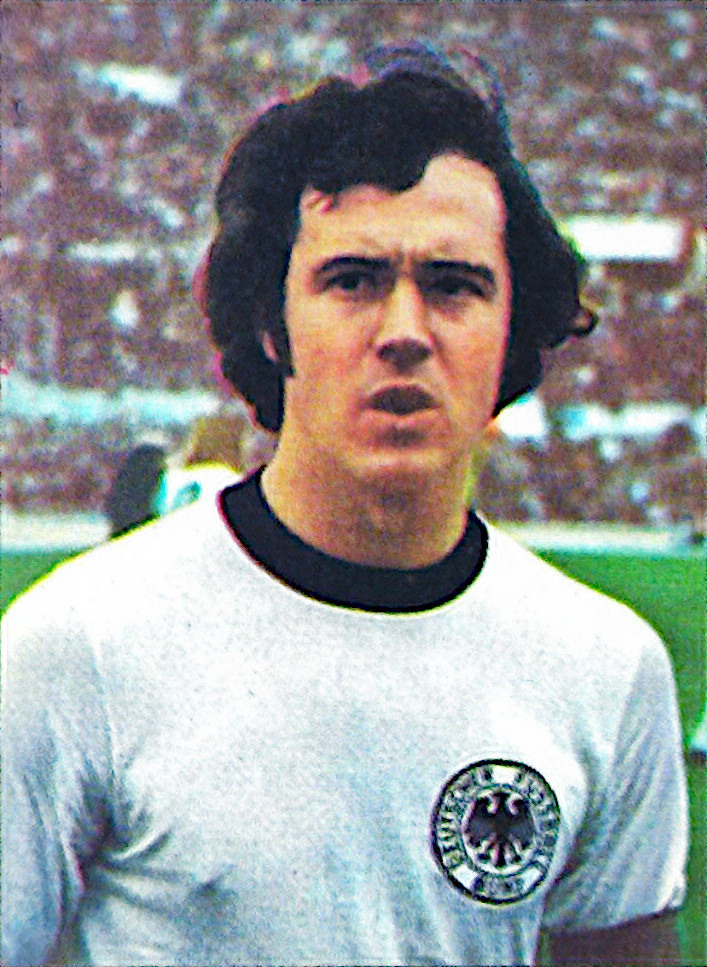
Franz Anton Beckenbauer, affectionately known as 'Der Kaiser' (The Emperor), was a towering figure in global football, leaving an indelible mark as both a player and a manager. Born on 11 September 1945, Beckenbauer's career spanned from 1964 to 1983, primarily defining an era of dominance for German football and Bayern Munich. His passing on 7 January 2024 marked the end of an era for one of the sport's most influential personalities. Beckenbauer is one of only three individuals in history to win the FIFA World Cup as both a player and a manager, a testament to his profound understanding of the game.
Position
Beckenbauer redefined the role of a defender. While listed as a defender, his most famous contribution was the invention and mastery of the modern sweeper, or 'libero,' role fifa.com. This position allowed him to break free from traditional defensive duties, enabling him to initiate attacks from deep, carry the ball forward, and dictate play from behind the midfield. His tactical innovation transformed the game, demonstrating that a defender could be a primary playmaker and an attacking threat.
Identity
Beyond his tactical genius, Beckenbauer was known for his elegant playing style, leadership, and composure under pressure. His nickname, 'Der Kaiser,' reflected his regal presence on the pitch, his authoritative command, and his ability to elevate the performance of those around him. He embodied the confidence and ambition that characterized German football during its golden age in the 1970s. His influence extended beyond his playing days, shaping the sport through his managerial career and subsequent roles as a football executive.
Career path
Franz Beckenbauer's club career was marked by extraordinary success and innovation, predominantly with Bayern Munich, but also with significant tenures in the North American Soccer League (NASL) and a brief return to the Bundesliga.
Bayern Munich (1964–1977)
Beckenbauer joined Bayern Munich's youth system in 1959. He made his senior debut for the club in 1964, quickly establishing himself as a fixture in the first team transfermarkt.com. His time at Bayern was the most decorated period of his playing career. He captained the club during a golden era, leading them to four Bundesliga titles (1969, 1972, 1973, 1974) and four DFB-Pokal victories (1966, 1967, 1969, 1971) en.wikipedia.org. Crucially, he also led Bayern to a historic hat-trick of European Cup wins in 1974, 1975, and 1976 uefa.com/uefachampionsleague. This period cemented his status as a global superstar and Bayern Munich as a European powerhouse.
New York Cosmos (1977–1980, 1983)
In 1977, Beckenbauer made a groundbreaking move to the New York Cosmos in the North American Soccer League (NASL), where he joined other legendary players like Pelé. His presence significantly elevated the profile of soccer in the United States. During his initial three-year spell, he led the Cosmos to three NASL Soccer Bowl championships (1977, 1978, 1980) en.wikipedia.org. He returned for a final season with the Cosmos in 1983, concluding his playing career there.
Hamburger SV (1980–1982)
Following his successful initial tenure with the New York Cosmos, Beckenbauer returned to Germany to play for Hamburger SV in 1980. He continued to demonstrate his enduring class, helping Hamburger SV win the Bundesliga title in the 1981–82 season transfermarkt.com. This final domestic title underscored his lasting impact and ability to influence games even in the twilight of his career before his last stint with the Cosmos.
Playing style
Franz Beckenbauer's playing style was characterized by an unparalleled elegance, tactical intelligence, and technical proficiency that revolutionized the defender's role. He was not merely a ball-winner; he was a ball-player, a playmaker operating from deep within his own half.
As the archetypal 'libero' or sweeper, Beckenbauer had the freedom to step out of defense and initiate attacks. His vision and passing range were exceptional, allowing him to launch pinpoint long passes to wingers or thread intricate through-balls to forwards. This ability to transition fluidly from defense to attack made him a constant threat and a crucial creative outlet for his teams fifa.com.
His dribbling skills were remarkable for a defender, enabling him to carry the ball out of pressure with grace and confidence. Beckenbauer possessed an almost effortless ability to glide past opponents, creating space and driving his team forward. His composure on the ball, even in tight situations, was a hallmark of his game. He rarely seemed flustered, always appearing in control, dictating the tempo from his unique position.
Defensively, while his primary role was not solely man-marking, he exhibited excellent positional awareness and anticipation. He would 'sweep' behind the main defenders, covering spaces and intercepting passes before danger materialized. His ability to read the game was second to none, allowing him to be in the right place at the right time to break up opposition attacks and then immediately launch a counter-attack.
Beckenbauer's influence on the game can be compared to modern ball-playing centre-backs like Sergio Ramos or Leonardo Bonucci, though Beckenbauer's offensive freedom as a libero was arguably greater. He demonstrated that a defender could be a team's primary creative engine, fundamentally altering tactical approaches to the game for generations to come.
Achievements & honours
Franz Beckenbauer's career was adorned with a remarkable collection of team and individual honours, firmly establishing him as one of football's all-time greats. His impact was recognized with two Ballon d'Or awards, making him one of the few defenders to win the coveted prize.
Individual Honours
- Ballon d'Or: 1972, 1976 en.wikipedia.org
- FIFA World Cup All-Star Team: 1966, 1970, 1974
- European Championship Team of the Tournament: 1972, 1976
- German Footballer of the Year: 1966, 1968, 1974, 1976
- FIFA 100: 2004
Club Honours
| Club | Competition | Year(s) |
|---|---|---|
| Bayern Munich | Bundesliga | 1968–69, 1971–72, 1972–73, 1973–74 |
| Bayern Munich | DFB-Pokal | 1965–66, 1966–67, 1968–69, 1970–71 |
| Bayern Munich | European Cup | 1973–74, 1974–75, 1975–76 uefa.com/uefachampionsleague |
| Bayern Munich | Cup Winners' Cup | 1966–67 |
| New York Cosmos | NASL Soccer Bowl | 1977, 1978, 1980 |
| Hamburger SV | Bundesliga | 1981–82 |
International Honours (as Player)
- FIFA World Cup: 1974 (as captain) fifa.com/worldcup
- UEFA European Championship: 1972 uefa.com/uefaeuro
Managerial Honours
- FIFA World Cup: 1990 (West Germany) fifa.com/worldcup
- Bundesliga: 1993–94 (Bayern Munich)
- UEFA Cup: 1995–96 (Bayern Munich)
International career
Franz Beckenbauer's international career for West Germany was as illustrious as his club exploits. He earned 103 caps and scored 14 goals for his country between 1965 and 1977, a significant tally for a defender of his era. His debut came in September 1965 against Sweden, a 2-1 World Cup qualifier victory en.wikipedia.org.
Beckenbauer participated in three FIFA World Cups. His first appearance was in 1966 in England, where West Germany reached the final, only to be defeated by the host nation. He famously played with a dislocated shoulder in the 1970 semi-final against Italy, showcasing his immense dedication and pain tolerance in what became known as the "Game of the Century."
The pinnacle of his international playing career arrived in 1972 when he captained West Germany to victory in the UEFA European Championship, defeating the Soviet Union 3-0 in the final uefa.com/uefaeuro. Two years later, on home soil, Beckenbauer led West Germany to an iconic 2-1 victory over the Netherlands in the 1974 FIFA World Cup final, solidifying his status as a national hero and one of the few players to lift both the European Championship and World Cup trophies.
His leadership and tactical influence were paramount in these successes, demonstrating his unique ability to command both his club and national teams to the highest honours in international football.
What makes Franz Beckenbauer stand out
Franz Beckenbauer stands out primarily for his revolutionary interpretation of the sweeper role and his unparalleled success as both a player and a manager. His transformation of the 'libero' position from a purely defensive role to a playmaking, attacking one was a tactical innovation that permanently altered how football was played. He wasn't just a defender; he was the orchestrator, the elegant pivot from which his teams built attacks.
Secondly, his leadership was profound. As captain of both Bayern Munich and West Germany, he exuded an aura of calm authority. He led by example, demonstrating composure and tactical brilliance under immense pressure, particularly in the 1974 World Cup and three European Cup finals. This combination of individual flair and galvanizing leadership made him truly unique.
Finally, Beckenbauer's achievement of winning the FIFA World Cup as both a player (1974) and a manager (1990) places him in an elite club of just three individuals, alongside Mário Zagallo and Didier Deschamps fifa.com. This dual success underscores his comprehensive understanding of the game from every conceivable angle, cementing his legacy as one of football's most influential and decorated figures.
“Beckenbauer was a true giant of world football. He was graceful, elegant, and stylish on the field and commanded respect off it.”