Overview
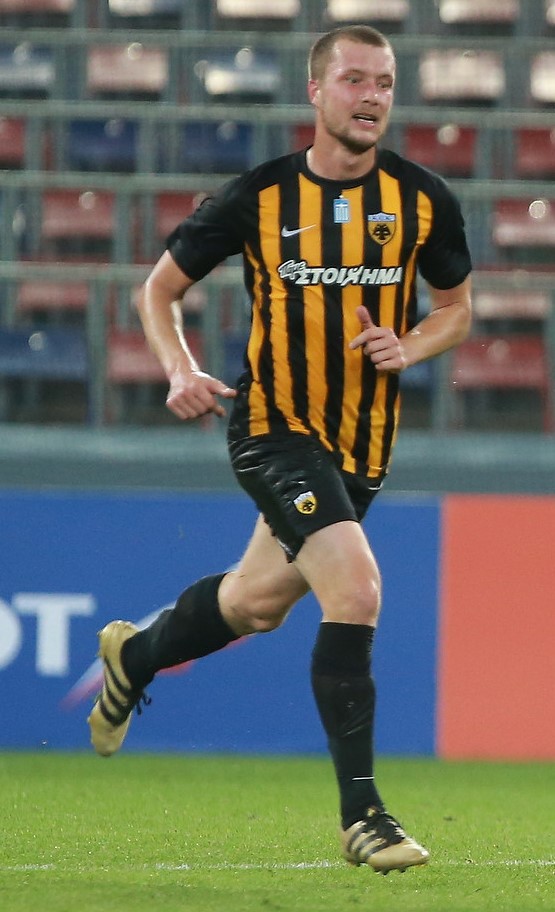
Jakob Johansson established himself as a prominent Swedish defensive midfielder throughout a career that spanned over a decade, primarily across Sweden, Greece, and France. Born on June 21, 1990, in Trollhättan, Johansson rose through the ranks of IFK Göteborg, a club where he spent the formative years of his senior career. His professional journey saw him become a key figure in the midfield for clubs like AEK Athens and Stade Rennais, known for his robust defensive capabilities and tactical intelligence.
Position
Johansson operated primarily as a defensive midfielder, a role in which he excelled at disrupting opposition attacks and providing a shield for the backline. His physical attributes, including his 1.87 m height, enabled him to be effective in aerial duels and to provide a strong presence in the central areas of the pitch. He was also capable of playing as a central midfielder, contributing to ball retention and initiating build-up play from deeper positions, though his defensive contributions were his most notable trait.
Identity
Often described as a diligent and disciplined player, Johansson's identity on the field was defined by his work rate and commitment to defensive duties. He was a player who prioritised the team's structure and balance, frequently making intelligent interceptions and tackles to regain possession. His ability to read the game and position himself effectively made him a reliable anchor in midfield, allowing more attack-minded players to flourish ahead of him. This understated but crucial role earned him recognition and a place in the Sweden national team squad, embodying the definition of a dependable midfield general.
Career path
Jakob Johansson's professional football career began in his native Sweden before taking him to top leagues in Greece and France. His development from a youth prospect to an international midfielder showcases a journey of consistent performance and adaptation.
IFK Göteborg (2007–2014)
Johansson began his youth career at Trollhättans FK before joining the academy of IFK Göteborg, one of Sweden's most successful clubs. He made his senior debut for the club in 2007, and over the course of seven seasons, he became an integral part of their midfield. During his tenure at IFK Göteborg, Johansson made over 150 appearances in the Allsvenskan, the top Swedish league. He played a significant role in the team that won the Svenska Cupen (Swedish Cup) in both 2008 and 2013, demonstrating his early ability to contribute to trophy-winning sides, as detailed on Jakob Johansson's Transfermarkt profile.
AEK Athens (2015–2018)
In January 2015, Johansson made the move to Greece, signing with AEK Athens. This transfer marked a significant step in his career, as he quickly established himself as a key player for the Greek giants. His time in Athens was highly successful, culminating in AEK Athens winning the Super League Greece title in the 2017–18 season. Johansson's performances in midfield were crucial to AEK's domestic success and their campaigns in European competitions. He made 101 appearances across all competitions for AEK, scoring 10 goals, before his departure in the summer of 2018, as documented by Wikipedia's article on Jakob Johansson.
Stade Rennais (2018–2020)
Following his successful spell in Greece, Johansson moved to France, joining Ligue 1 side Stade Rennais in the summer of 2018. His time at Rennes was unfortunately impacted by injuries, which limited his playing time. Despite these setbacks, he was part of the squad that famously won the Coupe de France in 2019, defeating Paris Saint-Germain in the final. This added another major honour to his club career, although his personal impact on the pitch was less frequent due to his physical challenges. He made 16 appearances for the French club over two seasons.
IFK Göteborg (2020–2021)
Johansson returned to IFK Göteborg in 2020, where he concluded his playing career. His return was met with enthusiasm from the club's faithful, but his injury issues persisted, eventually leading to his retirement from professional football in 2021. This final chapter brought his career full circle, ending where it began, after a journey that saw him compete at the highest levels in European football.
Playing style
Jakob Johansson's playing style was rooted in his effectiveness as a defensive midfielder, characterised by his strong positional sense, tackling ability, and aerial prowess. He was not typically a player who dominated possession with intricate passing, but rather one who provided crucial stability and protection to his team's defence.
His primary strength lay in his defensive contributions. Johansson consistently demonstrated an ability to read the game, anticipate opposition passes, and make timely interceptions. According to data available through platforms like Sofascore's player statistics, his statistics often highlighted a high volume of defensive actions per game, including successful tackles and clearances. He possessed a robust physical presence, which made him difficult to dispossess and effective in winning duels in the middle of the park.
In terms of distribution, Johansson typically opted for simple, efficient passes that maintained possession and recycled the ball, rather than attempting risky, penetrative balls. He was adept at linking play between the defence and midfield, ensuring smooth transitions and preventing turnovers in dangerous areas. His passing accuracy was generally high, reflecting his conservative yet effective approach to ball circulation.
Comparisons could be drawn to other industrious defensive midfielders known for their discipline and defensive solidity, such as Nemanja Matić in his prime or a more defensively focused version of Sergio Busquets, particularly in terms of positional intelligence and ability to break up play. While not a prolific goalscorer, Johansson occasionally contributed with goals, often from set-pieces due to his height and ability to find space in the box.
His work rate was another defining characteristic. Johansson consistently covered significant ground, tracking runners and supporting teammates both defensively and in transitions. This engine-room quality, combined with his tactical understanding, made him an invaluable asset for his managers, providing a dependable presence in the heart of the midfield.
Achievements & honours
Jakob Johansson enjoyed a successful club career, securing domestic cup and league titles across Sweden and Greece, in addition to a major cup honour in France. His contributions were instrumental in these triumphs, cementing his legacy as a winner at each of his primary clubs.
Club Honours
| Competition | Club | Year |
|---|---|---|
| Svenska Cupen | IFK Göteborg | 2008 |
| Svenska Cupen | IFK Göteborg | 2013 |
| Super League Greece | AEK Athens | 2017–18 |
| Coupe de France | Stade Rennais | 2018–19 |
His two Svenska Cupen titles with IFK Göteborg signify his early impact in his homeland, contributing to the club's success during his initial spell. The Super League Greece title with AEK Athens in the 2017–18 season was a particular highlight, as he played a pivotal role in their dominant league campaign, which saw them clinch their first league title in 24 years. Although his playing time was limited by injury at Stade Rennais, being part of the squad that lifted the Coupe de France in 2019 after a dramatic final against Paris Saint-Germain represents another significant achievement in his career, as confirmed by UEFA's report on the 2019 Coupe de France final. These collective honours underscore Johansson's consistent presence in competitive teams and his ability to contribute to winning environments.
International career
Jakob Johansson represented Sweden at various youth levels before making his senior international debut. His most significant contribution to the national team came during the qualification campaign for the 2018 FIFA World Cup.
Johansson earned 18 caps for the Sweden national team, making his debut in 2013. While he was a consistent presence in several squads, his most memorable moment came during the 2018 FIFA World Cup qualification play-offs against Italy. In the first leg, played on November 10, 2017, Johansson scored the only goal of the match, an important strike that gave Sweden a 1-0 aggregate lead. This goal proved decisive as Sweden ultimately held on for a 1-0 aggregate victory, securing their place at the World Cup in Russia. This pivotal goal is highlighted by FIFA's match report on the Sweden vs. Italy play-off.
Unfortunately, a serious knee injury sustained during the second leg of that same play-off against Italy curtailed his involvement in the World Cup itself and significantly impacted the latter part of his career. Despite the injury, his crucial goal against Italy remains a defining moment of his international career, etching his name into Swedish football history for his role in securing qualification for a major tournament. He also featured in several UEFA European Championship qualifiers and friendly matches, solidifying his role as a dependable option in the midfield for the national side during his active period.
What makes Jakob Johansson stand out
Jakob Johansson stood out primarily for his exceptional defensive intelligence and tactical discipline in midfield. Unlike many modern midfielders who are lauded for their attacking contributions, Johansson's value lay in his ability to consistently protect the back four, break up opposition play, and maintain positional integrity. His understanding of space and timing for interceptions was a hallmark of his game, allowing him to be in the right place at the right time to thwart attacks.
Another distinctive trait was his aerial ability and physical presence. At 1.87 m, he was formidable in winning duels, both defensively in his own box and occasionally contributing to attacking set-pieces. This dual threat made him a challenging opponent for smaller, more agile midfielders and provided his teams with a crucial advantage in contested areas. Furthermore, his leadership qualities, though often understated, were evident in his consistent work rate and commitment, setting an example for his teammates on the pitch.
"Jakob was the kind of player every coach appreciated. He did the dirty work, covered ground, and always prioritized the team's structure over individual flair."