Overview
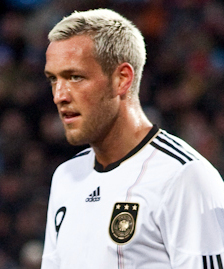
Julian Schieber, born on February 13, 1989, in Backnang, Germany, is a former professional footballer who carved out a notable career primarily as a centre-forward in the German Bundesliga. Standing at 1.86 meters, Schieber was a physically imposing presence on the pitch, known for his robust approach to attacking play. His career spanned several prominent German clubs, most notably VfB Stuttgart, Borussia Dortmund, and Hertha BSC, where he contributed goals and a tireless work ethic.
Position
Throughout his career, Julian Schieber operated predominantly as a central striker. His physical attributes made him well-suited to lead the line, often playing as a lone forward or as part of a front two. He excelled in roles that required him to hold up the ball, bring teammates into play, and act as a focal point for attacking moves. While primarily a striker, his high work rate also allowed him to press defenders effectively from the front.
Identity
Julian Schieber's professional identity was defined by his tenacity, aerial prowess, and commitment to team play. He was often described as a 'target man' due to his ability to win aerial duels and provide an outlet for long passes. Beyond his physical contributions, Schieber was valued for his unselfish running and defensive contributions, frequently tracking back and applying pressure to opposition defenders and midfielders. He was a player who consistently gave maximum effort, earning respect from coaches and fans alike for his dedication.
Career path
Julian Schieber's football journey began in the youth ranks before progressing to a professional career that saw him play for several established Bundesliga clubs.
Youth Career & VfB Stuttgart Debut
Schieber started his youth career at SV Söhnstetten and TSV Herbrechtingen before joining the academy of VfB Stuttgart in 2006. He quickly advanced through their youth system, making his senior debut for the club's reserve team, VfB Stuttgart II, in the Regionalliga Süd. His impressive performances earned him a call-up to the first team, making his Bundesliga debut for VfB Stuttgart on December 6, 2008, against Energie Cottbus in a 3-1 victory [Transfermarkt].
Loan Spell at FC Nürnberg
To gain more first-team experience, Schieber was loaned to 1. FC Nürnberg for the 2010-2011 season. During his time there, he became a regular starter, scoring 7 goals in 29 Bundesliga appearances and showcasing his potential as a reliable forward [Wikipedia]. This spell proved crucial in his development, as he returned to Stuttgart with enhanced confidence and capabilities.
Move to Borussia Dortmund
In July 2012, Schieber made a significant move to reigning Bundesliga champions Borussia Dortmund for a reported fee of €5 million [Transfermarkt]. He spent two seasons at Dortmund, often serving as a backup to Robert Lewandowski. Despite limited starts, he contributed to the team, notably scoring his first UEFA Champions League goal against Real Madrid in 2012 [UEFA Champions League]. He made 35 Bundesliga appearances, scoring 3 goals, and was part of the squad that reached the 2013 Champions League final.
Hertha BSC and Later Career
Seeking more regular playing time, Schieber transferred to Hertha BSC in July 2014 for €2.5 million [Transfermarkt]. He enjoyed a more prominent role in Berlin, although his time was frequently interrupted by injuries. Over four seasons, he played 58 league games, scoring 10 goals for Hertha. His final professional move was to FC Augsburg in July 2018 on a free transfer [Transfermarkt], where he spent two seasons before retiring from professional football in 2020 at the age of 31 due to persistent injury issues.
Playing style
Julian Schieber's playing style was characterized by a blend of physical attributes and a strong work ethic, making him an effective, albeit often unheralded, centre-forward. He was primarily a target man, adept at holding up the ball and bringing attacking midfielders and wingers into play.
One of his most prominent technical attributes was his aerial ability. Standing at 1.86 meters, Schieber was consistently competitive in the air, winning headers to flick on for teammates or to create chances from crosses. This made him a valuable asset for teams employing a direct style of play or looking to relieve pressure with long balls. His strength allowed him to effectively shield the ball from defenders, maintaining possession in advanced areas and drawing fouls.
Beyond his physical presence, Schieber possessed a commendable work rate. He was known for his relentless pressing of opposition defenders, aiming to disrupt their build-up play and force turnovers. This defensive contribution from a striker position was a key aspect of his game, making him a useful player in systems that demanded high-intensity pressing.
While not known for explosive pace or intricate dribbling, Schieber displayed intelligent movement off the ball, often finding pockets of space in the box or making runs to create opportunities for himself and others. His finishing was generally reliable within the penalty area, particularly when presented with clear-cut chances. According to FBref data for his Bundesliga seasons, his non-penalty expected goals (npxG) per 90 minutes suggests he was a consistent threat in front of goal when on the pitch.
Comparisons could be drawn to forwards like Sandro Wagner or even a younger Mario Gómez in terms of their physical presence and goal-poaching instincts within the box, though Schieber's career trajectory saw him often in a supporting role rather than the primary goalscorer. His commitment to the team's tactical framework, combined with his physical attributes, made him a valuable, if not always prolific, attacking option.
Achievements & honours
Julian Schieber's professional career saw him contribute to several successful teams, earning a collection of club honours, primarily during his tenure with Borussia Dortmund.
While individual accolades were not a central feature of his career, Schieber consistently played a role in squads that achieved significant success, particularly in the Bundesliga and DFB-Pokal competitions. His contributions, often from the bench or in rotation, were integral to team efforts.
A notable highlight of his career was being part of the Borussia Dortmund squad that reached the UEFA Champions League final in the 2012-2013 season, ultimately losing to Bayern Munich [UEFA Champions League]. While he did not play in the final, his presence and contributions in earlier rounds were part of the team's journey.
| Club | Competition | Year |
|---|---|---|
| Borussia Dortmund | DFL-Supercup | 2013 |
International career
Julian Schieber did not make a senior international appearance for the German national team. Despite a career that saw him play regularly in the Bundesliga for several seasons, he was never called up to the senior squad.
Schieber did, however, represent Germany at various youth levels. He featured for the Germany U20 team, earning caps and gaining experience in international competition during his formative years. These appearances provided him with an early taste of international football, contributing to his development as a professional player.
The competition for places in the German national team during Schieber's peak years was notably high, with a wealth of talent in the attacking positions. Germany's success in this period, including winning the 2014 FIFA World Cup [FIFA World Cup], meant that breaking into the senior squad was a significant challenge for many talented players.
While a senior international cap eluded him, his robust performances at club level were a testament to his quality as a professional footballer within the highly competitive German football landscape. His focus remained on his club commitments throughout his career, where he consistently delivered a strong work rate and physical presence.
What makes Julian Schieber stand out
Julian Schieber stood out primarily for his exceptional physical presence and his unwavering work rate as a centre-forward. In an era where many strikers prioritize technical finesse or blistering pace, Schieber offered a more traditional, robust approach to leading the line. His ability to consistently win aerial duels and hold up the ball against multiple defenders was a defining characteristic, providing a crucial outlet for his teams and allowing them to build attacks from deep within their half.
Another standout trait was his unselfishness and tactical discipline. Schieber was never purely a goalscorer; he understood and embraced the role of facilitating play for his teammates. His tireless pressing from the front was a significant defensive asset, disrupting opposition build-up and setting the tone for his team's defensive intensity. This commitment to the collective often earned him praise from coaches, even when he wasn't among the goals.
A signature moment that exemplifies his impact, beyond sheer statistics, was his goal for Borussia Dortmund against Real Madrid in the UEFA Champions League group stage in November 2012. It showcased his ability to contribute on the biggest stage, scoring a crucial equalizer in a memorable 2-2 draw [UEFA Champions League].
"Julian was always a player who gave everything for the team. His work rate and physical strength were invaluable."