Overview
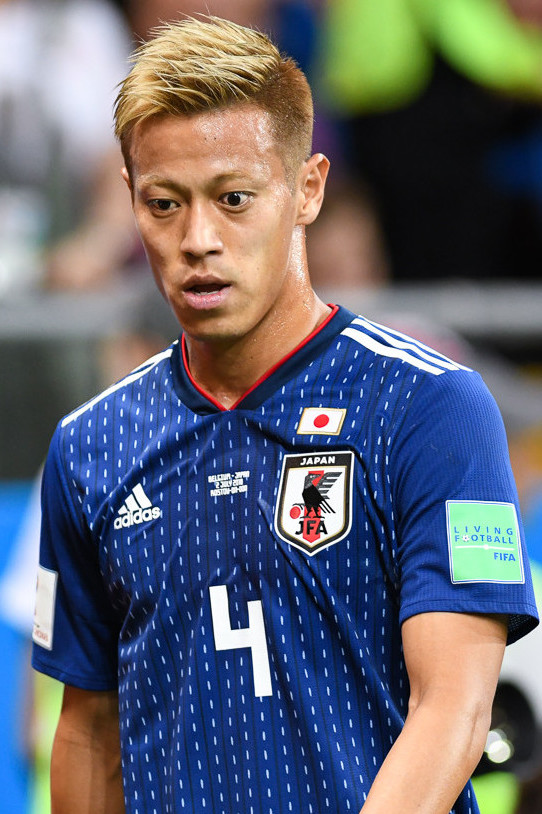
Keisuke Honda is a prominent figure in modern Japanese football, recognized for his impactful career as an attacking midfielder. Born in Osaka, Japan, on June 13, 1986, Honda's journey took him from his home country to Europe, North America, and Australia, showcasing a versatile skill set and a strong winning mentality. Standing at 1.82 meters, his physical presence, combined with his technical ability, allowed him to excel in various leagues. Honda is celebrated not only for his on-field contributions but also for his entrepreneurial ventures and coaching roles post-playing, illustrating his deep engagement with the sport beyond his playing days.
Position
Throughout his career, Keisuke Honda primarily operated as an attacking midfielder, often deployed in the number 10 role behind the striker. This position allowed him to dictate play, create scoring opportunities, and utilize his powerful shooting ability from outside the box. He also frequently featured as a right winger, cutting inside onto his dominant left foot, or even as a false nine in certain tactical setups. His adaptability meant he could influence games from various offensive positions, making him a valuable asset to his clubs and the national team.
Identity
Keisuke Honda's identity on the pitch was defined by his exceptional left foot, dead-ball expertise, and decisive goal-scoring ability. He was a player who consistently delivered in crucial moments, known for his composure under pressure and his leadership. His powerful long-range shots and pinpoint free-kicks became a trademark throughout his career. Beyond his technical skills, Honda was known for his strong character and ambition, often taking on leadership roles and inspiring his teammates. His career trajectory, moving from Japan to major European leagues, underscored his determination to compete at the highest level.
Career path
Keisuke Honda's football career began in his native Japan, progressing through youth academies before making his mark professionally. He joined the youth system of Gamba Osaka, a prominent club in the J1 League, before moving to Seiryō High School where he caught the attention of scouts. His professional debut came with Nagoya Grampus Eight in 2004, where he spent three successful seasons, establishing himself as a key player in the midfield.
VVV-Venlo (2008-2010)
In January 2008, Honda made his first move to Europe, signing with Dutch Eredivisie club VVV-Venlo. Initially, the team faced relegation to the Eerste Divisie, but Honda's performances were instrumental in their immediate return to the top flight. He became a fan favorite, known for his creative play and vital goals, culminating in him being named the Eerste Divisie's MVP for the 2008–09 season, as documented by Wikipedia's career overview.
CSKA Moscow (2010-2014)
His impressive form in the Netherlands earned him a transfer to Russian giants CSKA Moscow in January 2010, for a reported fee of around €6 million, according to Transfermarkt's transfer history. At CSKA, Honda experienced UEFA Champions League football and won the Russian Premier League title in the 2012–13 season, alongside two Russian Cups. He became a crucial player, particularly noted for his free-kick technique and assists.
AC Milan (2014-2017)
In January 2014, Honda joined Italian Serie A club AC Milan on a free transfer, a significant move that elevated his profile further. He spent three and a half seasons at the San Siro, making 92 appearances and scoring 11 goals in all competitions. His tenure at Milan, while not always consistent with team performance, saw him contribute important goals and moments, including his notable free-kick against Genoa in the 2014-15 season.
Pachuca (2017-2018)
Following his departure from Milan, Honda embarked on a new challenge, moving to Liga MX club Pachuca in 2017. He quickly adapted to Mexican football, scoring on his debut and showcasing his continued scoring prowess. His time in Mexico was brief but impactful, demonstrating his ability to perform in diverse footballing cultures.
Melbourne Victory (2018-2019)
In August 2018, Honda signed with Australian A-League club Melbourne Victory, where he served as a marquee player. His season in Australia was highly successful, both on and off the pitch, attracting significant attention to the league. He scored 8 goals in 23 appearances, becoming a fan favorite before moving on to further global ventures.
Later Career (2019-present)
Honda continued his nomadic career, with stints at Vitesse in the Netherlands (2019), Botafogo in Brazil (2020), Portimonense in Portugal (2021), Neftçi Baku in Azerbaijan (2021), and FK Sūduva in Lithuania (2021-2022). These moves highlighted his passion for the game and his desire to experience different footballing environments, even while taking on coaching roles simultaneously.
Playing style
Keisuke Honda's playing style was characterized by a unique blend of technical finesse, physical power, and tactical intelligence. As an attacking midfielder, his primary strengths revolved around his left foot, which he utilized for devastating long-range shots, precise passing, and exceptional set-piece delivery. He was often compared to players like Wesley Sneijder or Juan Román Riquelme for his ability to control the tempo of a game and deliver decisive passes.
One of Honda's most recognizable attributes was his shooting accuracy and power from distance. He possessed the ability to strike the ball cleanly and with significant force, making him a threat from outside the penalty area. This skill was particularly evident during his time at CSKA Moscow and AC Milan, where he frequently scored spectacular goals from open play and free-kicks. His free-kick technique was exemplary, often bending the ball over walls with dip and swerve, making him a specialist in dead-ball situations.
Beyond his striking ability, Honda was a highly intelligent player in possession. He demonstrated excellent vision and passing range, capable of unlocking defenses with through balls or switching play effectively. While not known for blistering pace, his tactical awareness allowed him to find pockets of space between the lines, receive the ball, and turn defenders. His dribbling was functional rather than flashy, used to maintain possession and drive forward rather than for elaborate trickery.
Defensively, Honda contributed with a strong work rate, particularly when playing on the wing. He was willing to track back and support his full-back, demonstrating a commitment to the team's defensive shape. While not a ball-winning midfielder, his positional discipline and ability to press at opportune moments added value to his teams. According to statistics from FBref's player statistics, Honda consistently maintained a high number of progressive passes and shot-creating actions throughout his career, underscoring his offensive influence.
Achievements & honours
Keisuke Honda's career is decorated with a variety of team trophies and individual accolades, reflecting his impact across different leagues and for his national team. His most notable team successes came during his time in Russia and with the Japan national team.
Club Honours
| Competition | Club | Year(s) |
|---|---|---|
| Eerste Divisie | VVV-Venlo | 2008–09 |
| Russian Premier League | CSKA Moscow | 2012–13 |
| Russian Cup | CSKA Moscow | 2010–11, 2012–13 |
| Russian Super Cup | CSKA Moscow | 2013 |
International Honours
For the Japan national team, Honda was a pivotal player during a successful period. He won the AFC Asian Cup in 2011, where he was also named the tournament's Most Valuable Player. This achievement is officially recognized by the Asian Football Confederation.
Individual Awards
- Eerste Divisie MVP: 2008–09
- AFC Asian Cup MVP: 2011
- Japanese Footballer of the Year: 2010
- AFC Asian International Player of the Year: 2014
Honda's consistent performances and leadership earned him recognition both domestically and continentally, solidifying his status as one of Japan's most influential footballers of his generation.
International career
Keisuke Honda was a cornerstone of the Japan national team for over a decade, earning 98 caps and scoring 37 goals, making him one of the country's all-time leading goalscorers. His international debut came on June 22, 2008, in a 1–0 victory against Bahrain.
He represented Japan in three consecutive FIFA World Cups: 2010 in South Africa, 2014 in Brazil, and 2018 in Russia. In the 2010 World Cup, he scored a crucial goal against Cameroon, contributing to Japan's progression to the Round of 16. His performances in major tournaments were consistently impactful. The 2018 FIFA World Cup saw him become the first Japanese player to score in three different World Cups, a significant milestone detailed on FIFA's official World Cup player profile.
Honda was also a central figure in Japan's triumph at the 2011 AFC Asian Cup, where he was named the tournament's Most Valuable Player. His leadership, set-piece delivery, and ability to score vital goals were key to Japan securing the continental title. He captained the national team on several occasions, demonstrating his influence and respected standing within the squad. His international career concluded after the 2018 FIFA World Cup, leaving behind a legacy of dedication and memorable moments for the Blue Samurai.
What makes Keisuke Honda stand out
Keisuke Honda stood out due to a unique combination of his powerful left foot, exceptional dead-ball ability, and an unyielding winning mentality. His capacity to score from long range, particularly from free-kicks, made him a constant threat and a specialist in situations that often decide tight matches. This distinct skill set allowed him to influence games even when not overtly involved in open play, turning set-pieces into genuine goal-scoring opportunities.
Another defining characteristic was his adaptability and willingness to embrace new challenges across diverse footballing cultures. From the Eredivisie to the Russian Premier League, Serie A, Liga MX, and the A-League, Honda consistently performed, proving his quality in different tactical environments and climates. This global journey, including his role as general manager for the Cambodian national team while still playing, highlighted his broader vision for football and his ambition to leave a lasting mark beyond his playing career.
"Honda has a mentality that is rare. He wants to win, always, and he pushes himself and his teammates to achieve it, no matter the situation."