Overview
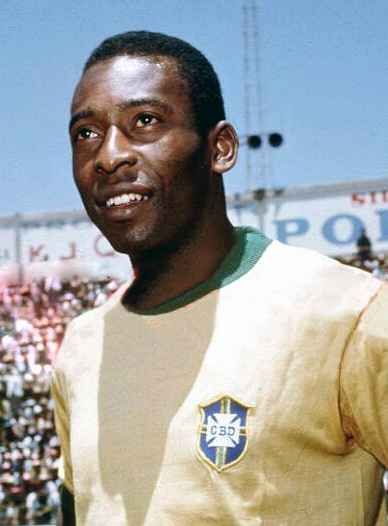
Edson Arantes do Nascimento, globally revered as Pelé, was a Brazilian professional footballer whose career defined an era of the sport from 1956 to 1977. Born on October 23, 1940, Pelé emerged from humble beginnings to become a transcendent figure in football, earning the nickname 'O Rei' (The King) for his unparalleled achievements and influence. Primarily operating as a forward, Pelé was known for his exceptional goal-scoring ability, creative playmaking, and athletic prowess. His legacy is most profoundly marked by being the only player in history to win three FIFA World Cups, a feat he accomplished with the Brazil national team in 1958, 1962, and 1970 FIFA.com.
Position
Pelé played predominantly as an attacking forward, often deployed as a central striker or an inside forward. His role was dynamic, allowing him to drop deep to link play, drift wide to create space, and, most famously, burst into the box to score. This versatility was a hallmark of his game, enabling him to adapt to different tactical setups and exploit various defensive weaknesses. He combined the predatory instincts of a pure goalscorer with the vision and passing range of a playmaker.
Identity
Pelé's identity in football is synonymous with excellence, innovation, and global ambassadorship. He was not merely a prolific goalscorer; he was an entertainer who captivated audiences with his skill, flair, and sportsmanship. His rise to prominence coincided with the global popularization of football, and he became the sport's first truly international superstar. Beyond his on-field achievements, Pelé was recognized for his character and his role in promoting peace and understanding through football, solidifying his status as a cultural icon FIFA.com.
Career path
Pelé's extraordinary career began in Brazil, where he quickly rose through the ranks to become a global phenomenon before concluding his playing days in the United States.
Santos FC (1956-1974)
Pelé joined Santos FC in 1956 at the age of 15, making his senior debut later that year Transfermarkt.com. His impact was immediate, scoring on his debut against Corinthians Santo André. By 1957, he was the top scorer in the Campeonato Paulista, a feat he would repeat numerous times. During his 18 years with Santos, Pelé led the club to unprecedented success, including six Campeonato Brasileiro Série A titles (1961, 1962, 1963, 1964, 1965, 1968), two Copa Libertadores titles (1962, 1963), and two Intercontinental Cups (1962, 1963) Wikipedia.org. He became the club's all-time leading scorer, netting hundreds of goals and establishing Santos as one of the most formidable teams in world football. His tenure at Santos saw the club embark on numerous international tours, showcasing Pelé's talent to audiences across the globe and significantly contributing to his international fame.
New York Cosmos (1975-1977)
After a brief period of retirement from Brazilian club football, Pelé was enticed to join the New York Cosmos of the North American Soccer League (NASL) in 1975 Transfermarkt.com. This move was pivotal for the growth of soccer in the United States, bringing unprecedented attention to the league and the sport. Pelé's arrival sparked a surge in attendance and interest, attracting other international stars to the NASL. During his three seasons with the Cosmos, he led the team to the NASL championship in 1977, his final professional season. His farewell match, an exhibition between the Cosmos and Santos, symbolized the full circle of his legendary career, playing one half for each club. Pelé's time in the NASL cemented his status as a global ambassador for football, leaving an indelible mark on the sport's development in North America.
Playing style
Pelé's playing style was characterized by a rare combination of athletic power, technical brilliance, and tactical intelligence, making him a truly complete forward. He possessed exceptional dribbling ability, often weaving past multiple defenders with close control and deceptive changes of pace. His two-footedness was a significant asset, allowing him to shoot and pass effectively with either foot, making him unpredictable for opponents Wikipedia.org.
Known for his extraordinary goal-scoring prowess, Pelé had a powerful and accurate shot from various ranges. He was also an accomplished header of the ball, despite not being exceptionally tall, demonstrating excellent timing and leap. Beyond his finishing, Pelé was a highly creative player with superb vision and passing accuracy, often initiating attacks and providing assists for teammates. He could operate effectively as a traditional number 9, a deep-lying forward, or even a wide attacker, adapting his game to the tactical needs of his team.
His physical attributes included remarkable stamina and strength, allowing him to withstand challenges and maintain a high level of performance throughout matches. Pelé also displayed exceptional spatial awareness and anticipation, often positioning himself optimally to receive passes or intercept opponent's plays. His ability to read the game, combined with his explosive acceleration, made him a constant threat in the final third. Comparatively, elements of his all-around game, such as his combination of scoring and playmaking, might be seen in modern forwards like Lionel Messi or Cristiano Ronaldo, though Pelé’s era presented different tactical challenges and physical demands FBref.com. His versatility and mastery of fundamental skills across the attacking spectrum set him apart as a truly unique talent.
Achievements & honours
Pelé's career was adorned with numerous team titles and individual accolades, solidifying his status as one of football's all-time greats. His unique record of three FIFA World Cup victories remains unmatched by any other player.
Team Honours
| Competition | Club / National Team | Years |
|---|---|---|
| FIFA World Cup | Brazil | 1958, 1962, 1970 |
| Campeonato Brasileiro Série A | Santos FC | 1961, 1962, 1963, 1964, 1965, 1968 |
| Copa Libertadores | Santos FC | 1962, 1963 |
| Intercontinental Cup | Santos FC | 1962, 1963 |
| NASL Soccer Bowl | New York Cosmos | 1977 |
Individual Awards & Records
- FIFA Player of the Century (awarded jointly with Diego Maradona) FIFA.com
- 1281 official goals across career (Guinness World Record) Wikipedia.org
- Only player to win 3 FIFA World Cups
- Brazil's all-time leading goal scorer (77 goals in 92 caps) FIFA.com
- South American Footballer of the Year: 1973
- IOC Athlete of the Century: 1999
International career
Pelé's international career with the Brazil national team is legendary, marked by unparalleled success and iconic performances on the world stage. He made his debut for Brazil at the age of 16 in July 1957, scoring against Argentina FIFA.com. Over his 14-year international career, Pelé earned 92 caps and scored 77 goals, making him Brazil's all-time leading goal scorer, a record he held for many decades FIFA.com.
His most significant achievements came in the FIFA World Cup. At the 1958 World Cup in Sweden, a 17-year-old Pelé burst onto the scene, scoring six goals, including a hat-trick in the semi-final against France and two in the final against Sweden, leading Brazil to their first World Cup title. He became the youngest player to score in a World Cup final FIFA.com/worldcup.
In the 1962 World Cup in Chile, Pelé played a crucial role in Brazil's early matches, scoring and assisting before an injury sidelined him. Despite his absence from the latter stages, Brazil went on to win the tournament, securing his second World Cup winner's medal. The 1966 World Cup in England was a disappointing campaign for Brazil and Pelé, as he was targeted by opponents and injured, leading to Brazil's early exit.
Pelé's international career culminated gloriously at the 1970 World Cup in Mexico. Leading a star-studded Brazilian side, he delivered a masterclass, scoring four goals, including the opening goal in the final against Italy, and providing numerous assists. This tournament is often considered one of the greatest team performances in World Cup history, and Pelé's role as the orchestrator was central to Brazil's third triumph, which allowed them to keep the Jules Rimet trophy permanently FIFA.com/worldcup.
What makes Pelé stand out
Pelé stood out due to a confluence of factors: his unparalleled versatility, his consistent excellence on the biggest stages, and his pioneering role in globalizing football. His ability to perform every attacking function – from scoring spectacular goals with either foot or head, to orchestrating play with visionary passes, and even contributing defensively – made him incredibly difficult to contain. This all-around competency set him apart from many of his contemporaries and successors who often specialized in one or two areas.
Furthermore, Pelé's composure and ability to deliver under immense pressure were evident throughout his career, particularly in his three FIFA World Cup victories. His performances in the 1958 and 1970 finals are iconic examples of a player rising to the occasion when it mattered most. He was not just a great player; he was a winner who consistently elevated his team's performance. His global tours with Santos and his move to the New York Cosmos were instrumental in expanding football's reach, especially in North America, long before it became a mainstream sport there.
"Pelé revolutionized football. He was a complete player, a true artist on the field." – Franz Beckenbauer