Overview
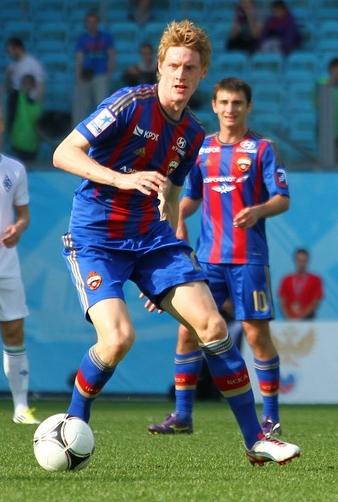
Rasmus Elm is a former Swedish professional footballer, born on 17 March 1988, who predominantly operated in central midfield. Standing at 1.84 m, Elm was recognized for his elegant playing style, characterized by a sophisticated passing range, tactical intelligence, and proficiency from set-pieces. His career spanned successful periods in Sweden, the Netherlands, and Russia, where he garnered numerous team honors and individual plaudits. A product of the Kalmar FF youth system, Elm rose through the ranks alongside his brothers Viktor and David, establishing a notable family legacy at the club.
Position
Elm primarily functioned as a deep-lying playmaker or a central midfielder in a box-to-box role. His ability to dictate the tempo of a game from the middle of the park was a defining aspect of his play. He possessed the technical attributes to excel both in breaking up opposition attacks and initiating offensive movements with accurate long and short passes. His versatility also allowed him to play in a more advanced attacking midfield position when required, leveraging his vision and shooting ability from distance.
Identity
Rasmus Elm's footballing identity was that of a 'quarterback midfielder' – a player capable of orchestrating play from deep, spraying passes across the pitch, and delivering dangerous set-pieces. His calm demeanor on the ball and decision-making under pressure made him a pivotal figure in the teams he represented. Despite battling chronic health issues later in his career, his technical quality and footballing intelligence remained evident, making him a respected figure in Swedish football.
Career path
Rasmus Elm's professional journey began at his hometown club Kalmar FF, where he progressed through the youth ranks. He made his senior debut for the club in 2005 at the age of 17, quickly establishing himself as a key player in the Allsvenskan. His tenure at Kalmar FF culminated in the club's historic 2008 Allsvenskan title, a season in which Elm was instrumental.
AZ Alkmaar (2009–2012)
Following his success in Sweden, Elm attracted interest from several European clubs, eventually making a move to Dutch Eredivisie side AZ Alkmaar in August 2009 for an undisclosed fee, as documented by Transfermarkt. At Alkmaar, Elm continued to develop his reputation as a creative midfielder. He played a crucial role in the team, contributing with goals and assists, and helped AZ secure the KNVB Cup in the 2012-13 season, although he had already departed by the time of the final. His consistent performances in the Eredivisie further highlighted his ability to perform at a higher European level.
CSKA Moscow (2012–2015)
In July 2012, Elm transferred to Russian Premier League giants CSKA Moscow for a reported fee of €6 million, according to Transfermarkt. This move marked a significant step up in his career, offering him the chance to compete in the UEFA Champions League. At CSKA, Elm quickly became an integral part of the midfield, famed for his precise passing and powerful long-range efforts. He played a pivotal role in CSKA winning two Russian Premier League titles in 2012–13 and 2013–14, as well as the Russian Cup in 2012–13. His time in Moscow was highly successful on the pitch, but it was also during this period that he began to experience health issues that would eventually impact his career longevity.
Return to Kalmar FF (2015–2020)
Due to ongoing health problems, Rasmus Elm made the decision to return to Kalmar FF in January 2015, prioritizing his well-being. His second spell at his boyhood club allowed him to manage his condition while still contributing to the team. Although his playing time was more limited and intermittent compared to his earlier career, his experience and technical quality remained invaluable to Kalmar. He officially retired from professional football in 2020, concluding a career that, despite its challenges, left a lasting impact.
Playing style
Rasmus Elm was a quintessential deep-lying playmaker, often compared to the likes of Andrea Pirlo or Xabi Alonso for his ability to control the midfield tempo and distribute the ball with precision. His primary strength lay in his exceptional vision and passing range, allowing him to launch attacks with pinpoint long balls or intricately combine in tight spaces. Data from his peak seasons, particularly at AZ Alkmaar and CSKA Moscow, would likely highlight high pass completion rates and a significant number of key passes per game.
His left foot was a significant asset, not only for open play distribution but also for his prowess from set-pieces. Elm was renowned for his ability to deliver dangerous corners, free-kicks, and for his direct free-kick taking, often bending the ball with accuracy and power. This made him a constant threat from dead-ball situations, frequently converting free-kicks or creating scoring opportunities for teammates. His shooting from outside the box was also a notable feature, with several memorable long-range goals throughout his career.
Beyond his offensive contributions, Elm possessed a strong understanding of the game's tactical nuances. He was adept at positioning himself to intercept passes, break up play, and initiate counter-attacks. While not known for blistering pace, his intelligent movement and ability to read the game compensated for any lack of athletic explosiveness. His defensive work rate, though not always highlighted, was consistent, providing a balance to his creative responsibilities. His composure under pressure was another defining trait, enabling him to retain possession and make effective decisions even in congested midfield areas. His overall style was one of elegance and efficiency, a player who made the game look effortless through his technical mastery and tactical mind.
Achievements & honours
Rasmus Elm's career, though affected by health issues, was marked by significant club and individual success, particularly during his time in Sweden and Russia. He played a crucial role in several championship-winning teams, leaving a legacy of a highly influential midfielder.
Club Honours
| Competition | Club | Year(s) |
|---|---|---|
| Allsvenskan | Kalmar FF | 2008 |
| Russian Premier League | CSKA Moscow | 2012–13, 2013–14 |
| Russian Cup | CSKA Moscow | 2012–13 |
| Russian Super Cup | CSKA Moscow | 2013, 2014 |
Individual Accolades
While specific individual awards like 'Player of the Year' are not extensively documented across all leagues he played in, Elm was consistently recognized in team of the season selections during his peak years in the Eredivisie and Russian Premier League. His performances were frequently lauded by coaches and pundits for his technical skill and influence on games. He was also a regular feature in the Sweden national team during his prime, underscoring his standing as one of the country's top midfielders.
International career
Rasmus Elm represented Sweden at various youth levels before making his senior international debut. He earned his first cap for the Sweden national team in 2009. Over his international career, Elm amassed 39 caps and scored 4 goals for his country, establishing himself as a key figure in the Swedish midfield for several years.
He was part of the Sweden squad for the UEFA Euro 2012 tournament, held in Poland and Ukraine. During the tournament, Elm featured in all three of Sweden's group stage matches, including their memorable 2-0 victory over France. His calm presence and distribution abilities were vital in the national team's efforts to compete against Europe's elite. Elm's international career saw him participate in qualifying campaigns for both the FIFA World Cup and UEFA European Championship, where his set-piece delivery and midfield control were highly valued.
His most notable international goal arguably came in a 2014 FIFA World Cup qualifier against Germany in October 2012. Elm scored a dramatic injury-time equalizer, completing Sweden's comeback from a 4-0 deficit to draw 4-4 in Berlin, a result that sent shockwaves through the football world. This goal underscored his composure and ability to perform under pressure on the biggest stages. His international career concluded with his retirement from the national team in 2015 due to ongoing health problems.
What makes Rasmus Elm stand out
Rasmus Elm distinguished himself through a unique blend of technical finesse, tactical acumen, and a remarkable ability from dead-ball situations. His vision and passing range were truly elite, allowing him to unlock defenses with precise through balls or switch play with effortless long passes. This made him a central figure in orchestrating attacks, often dictating the rhythm of his team's play from deep within the midfield.
Furthermore, Elm's mastery over set-pieces was a standout trait. Whether it was curling free-kicks directly into the net, delivering dangerous crosses from corners, or providing accurate deliveries from wide free-kicks, he consistently posed a threat. This specialized skill added another dimension to his game, making him invaluable in tight matches where a moment of magic from a dead ball could turn the tide. His famous equalizer against Germany from a free-kick perfectly encapsulates this ability.
"Rasmus has a fantastic left foot, he sees passes that others don't, and he's a real leader on the pitch."