Overview
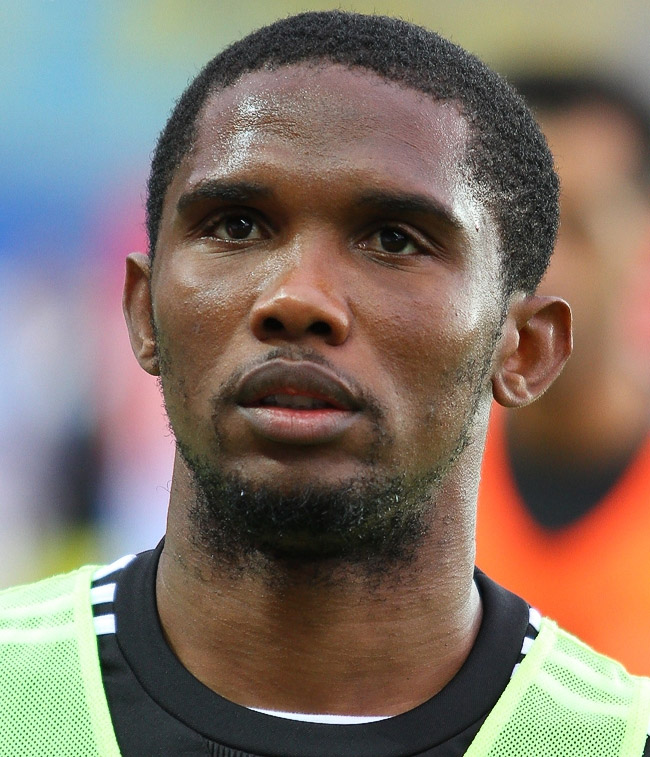
Samuel Eto'o Fils, born on 10 March 1981 in Nkon, Cameroon, is a retired professional footballer celebrated for his career as a formidable striker. Standing at 1.80 meters, Eto'o was a dynamic and prolific goalscorer who enjoyed considerable success across Europe's top leagues and was a pivotal figure for the Cameroon national team. His career spanned multiple decades, earning him widespread recognition as one of the most decorated African players in football history. Eto'o's influence extended beyond his goalscoring prowess, encompassing leadership qualities and a formidable presence on the pitch.
Position
Eto'o primarily operated as a centre-forward, leading the line for his clubs and country. He possessed the versatility to play across the attacking front, often drifting wide or dropping deeper to link play, but his most impactful role was as the main striker. His ability to exploit defensive spaces, combined with his acceleration, made him a constant threat in the final third. Throughout his career, Eto'o maintained a high level of performance in this demanding position, adapting his game to various tactical systems and remaining a prolific scorer.
Identity
Samuel Eto'o's football identity is defined by his blend of athletic power, technical skill, and an insatiable desire to win. He was renowned for his blistering pace, which allowed him to beat defenders to the ball and break away into goal-scoring positions. Coupled with this speed was a precise and powerful shot, making him clinical in front of goal. Eto'o's relentless work rate and defensive contributions, particularly in pressing opponents, also set him apart, showcasing a commitment beyond just scoring goals. He was a natural leader, often captaining his teams and inspiring those around him through his performances and competitive spirit.
Career path
Samuel Eto'o's journey in professional football began in his native Cameroon before he moved to Spain at a young age, embarking on a career that would see him play for some of Europe's most prestigious clubs.
Real Madrid and Early Loans (1997–2000)
Eto'o joined the Real Madrid youth academy in 1997. However, he found first-team opportunities limited and was subsequently loaned out to Leganés in the Segunda División during the 1997–98 season, where he made 30 appearances, scoring 4 goals (Transfermarkt). Further loan spells followed at Espanyol in 1999 and Mallorca from 1999 to 2000, where he began to establish himself as a promising talent in La Liga.
RCD Mallorca (2000–2004)
After a successful loan period, RCD Mallorca signed Eto'o permanently in 2000. It was with Mallorca that he truly made his mark, becoming a key player and helping the club win the Copa del Rey in 2003, their first major trophy. During his time at Mallorca, Eto'o scored 54 goals in 133 appearances across all competitions (Wikipedia), attracting attention from top European clubs.
FC Barcelona (2004–2009)
In 2004, Eto'o made a high-profile move to FC Barcelona. This period marked the most successful phase of his club career. He played a crucial role in Barcelona's dominance, winning three La Liga titles, two UEFA Champions League titles, and one Copa del Rey. Eto'o scored in both the 2006 and 2009 Champions League finals, cementing his legacy as a big-game player. He netted 130 goals in 199 appearances for the Catalan giants before departing in 2009 (Transfermarkt).
Inter Milan (2009–2011)
Eto'o moved to Inter Milan in 2009 as part of a swap deal involving Zlatan Ibrahimović. Under José Mourinho, he continued his winning ways, achieving an unprecedented treble in his first season: the Serie A title, the Coppa Italia, and his third UEFA Champions League trophy in 2010. He scored 53 goals in 102 appearances for Inter, showcasing his adaptability to Italian football (Wikipedia).
Later Career (2011–2019)
Following his success in Italy, Eto'o moved to Anzhi Makhachkala in Russia (2011–2013), then returned to England for spells with Chelsea (2013–2014) and Everton (2014–2015). He continued his career in Turkey with Antalyaspor (2015–2018) and Konyaspor (2018), and finally in Qatar with Qatar SC (2018–2019) before announcing his retirement from football in September 2019.
Playing style
Samuel Eto'o was a quintessential modern striker, combining exceptional physical attributes with refined technical skills and a high footballing IQ. His playing style was characterized by relentless movement, clinical finishing, and surprising versatility.
Pace and Agility: Eto'o's most striking attribute was his explosive speed and acceleration. This allowed him to consistently beat defenders in foot races, make incisive runs in behind, and quickly close down opponents. His agility enabled him to change direction rapidly, making him difficult to mark in tight spaces and a constant threat on the counter-attack, similar to the early career of Thierry Henry (FBref).
Finishing and Goal Poaching: A natural goalscorer, Eto'o possessed a wide range of finishing techniques. He was adept at using both feet, comfortable with volleys, and precise with placed shots inside the box. His intelligent movement without the ball created numerous goal-scoring opportunities, demonstrating a poacher's instinct. He consistently ranked among the top scorers in the leagues he played in, with a notable conversion rate, particularly during his time at Barcelona and Inter Milan (Sofascore).
Work Rate and Pressing: Beyond his offensive contributions, Eto'o was known for his exceptional work rate. He was often the first defender from the front, initiating presses against opposition defenders and goalkeepers. This defensive effort was a hallmark of his game, especially under coaches like Pep Guardiola and José Mourinho, who valued high pressing from their forwards. This facet of his game drew comparisons to players like Luis Suárez in terms of defensive contribution from an attacking role.
Link-Up Play and Dribbling: While primarily a goalscorer, Eto'o was also capable of good link-up play. He could hold up the ball, bring midfielders into play, and execute quick one-two passes. His dribbling ability, particularly in tight areas and when running at pace, allowed him to bypass defenders and create chances for himself or teammates. This made him a more complete forward than many pure poachers.
Achievements & honours
Samuel Eto'o's career was adorned with numerous individual and team accolades, underscoring his status as an elite footballer.
Club Honours
| Competition | Club | Year(s) |
|---|---|---|
| Copa del Rey | RCD Mallorca | 2003 |
| La Liga | FC Barcelona | 2004–05, 2005–06, 2008–09 |
| Supercopa de España | FC Barcelona | 2005, 2006 |
| UEFA Champions League | FC Barcelona | 2005–06, 2008–09 |
| Serie A | Inter Milan | 2009–10 |
| Coppa Italia | Inter Milan | 2009–10, 2010–11 |
| Supercoppa Italiana | Inter Milan | 2010 |
| UEFA Champions League | Inter Milan | 2009–10 |
| FIFA Club World Cup | Inter Milan | 2010 |
Individual Honours
- African Player of the Year: 2003, 2004, 2005, 2010 (Wikipedia)
- FIFA FIFPro World XI: 2005, 2006 (Wikipedia)
- UEFA Team of the Year: 2005, 2006 (Wikipedia)
- La Liga Top Scorer (Pichichi Trophy): 2005–06
- Africa Cup of Nations Top Scorer: 2006, 2008
- FIFA Club World Cup Golden Ball: 2010
International career
Samuel Eto'o's international career with the Cameroon national team, known as the "Indomitable Lions," was extensive and highly decorated. He made his debut for Cameroon one day before his 16th birthday, on 9 March 1997, in a friendly against Costa Rica (Wikipedia). Eto'o went on to become Cameroon's all-time leading goalscorer with 56 goals and is their third-most capped player with 118 appearances (FIFA).
He participated in four FIFA World Cups: 1998, 2002, 2010, and 2014. While Cameroon struggled to advance beyond the group stage in these tournaments, Eto'o was invariably their most prominent player and leader, scoring goals and providing moments of individual brilliance. His presence at multiple World Cups underscores his longevity and importance to the national side.
Eto'o's greatest international successes came in the Africa Cup of Nations. He played a pivotal role in Cameroon's back-to-back triumphs in 2000 and 2002, securing two continental titles. He is also the all-time leading goalscorer in Africa Cup of Nations history with 18 goals (Wikipedia). His performances in these tournaments often earned him individual accolades, including being the top scorer in the 2006 and 2008 editions. Eto'o also won an Olympic gold medal with Cameroon at the 2000 Sydney Games, a significant achievement for African football.
What makes Samuel Eto'o stand out
Samuel Eto'o's standout quality was his unique combination of raw athleticism, clinical finishing, and an elite mentality. His ability to score goals in big matches, consistently perform at the highest level for over a decade, and adapt his game to different leagues and tactical systems made him truly exceptional. He possessed an innate understanding of space and timing in the penalty area, allowing him to be in the right place at the right time for crucial finishes.
Beyond his goalscoring, Eto'o's relentless energy and defensive contributions from the front were unparalleled for a player of his attacking prowess. This commitment to the team's overall effort made him invaluable to coaches like Pep Guardiola and José Mourinho. His leadership, both by example and through motivation, also set him apart, especially during his captaincy for Cameroon.
"Samuel Eto'o is a born winner. He scores goals, he works hard, and he has a fantastic mentality." – José Mourinho (Wikipedia)