Overview
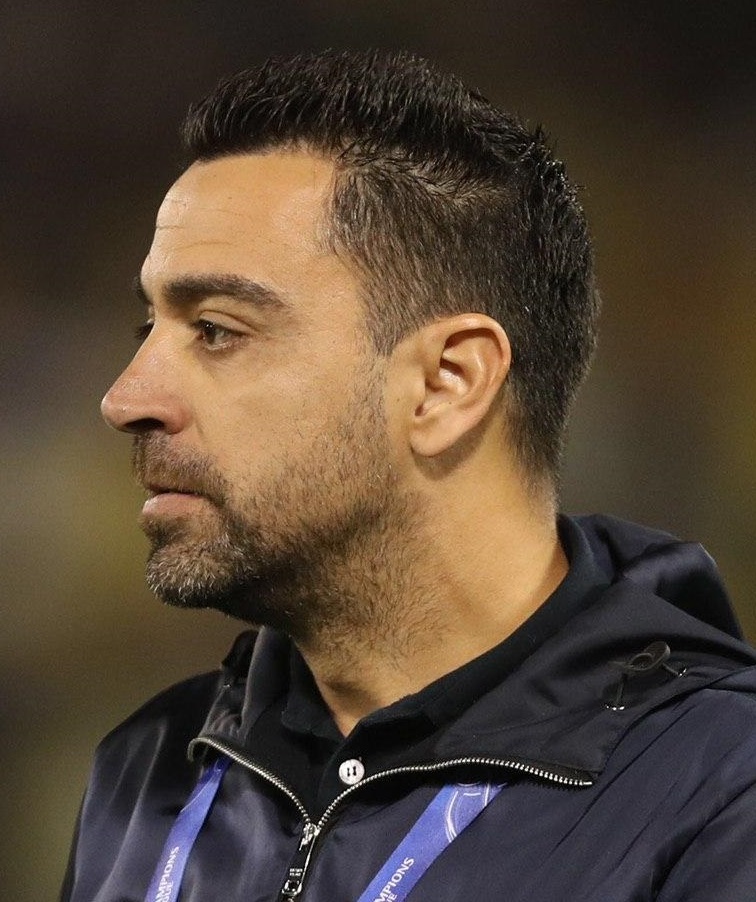
Xavier Hernández Creus, universally known as Xavi, stands as one of the most influential central midfielders in modern football history. Born on January 25, 1980, in Terrassa, Spain, Xavi rose through the ranks of FC Barcelona's famed La Masia academy to become the heartbeat of arguably the greatest club side of all time. His career, spanning from 1998 to 2019, was defined by an unparalleled mastery of possession-based football, often termed 'tiki-taka'.
Position
Xavi primarily operated as a deep-lying playmaker or central midfielder. His role was to dictate the tempo of the game, control possession, and initiate attacking moves from the middle third of the pitch. He was exceptional at receiving the ball under pressure, shielding it, and distributing it with precision, often making complex plays appear simple. His spatial awareness and ability to find pockets of space were crucial to his effectiveness in central areas.
Identity
Xavi's identity as a player is synonymous with intelligence, technical brilliance, and leadership. He was the quintessential 'metronome' – a player whose consistent, intelligent passing kept his team ticking. His partnership with Andrés Iniesta for both Barcelona and the Spain national team is widely regarded as one of the most iconic midfield duos, forming the creative engine behind a period of unprecedented success. He embodied the philosophy of total football, emphasizing ball retention and collective movement.
Legacy
Xavi's legacy extends beyond his numerous trophies. He redefined the role of a central midfielder, proving that physical dominance was not a prerequisite for controlling a game. His influence on young midfielders globally, particularly those coming through Spanish academies, is profound, with many aspiring to emulate his vision and passing range. He concluded his playing career with Al Sadd in Qatar, later transitioning into management with the same club before returning to Barcelona as head coach.
Career path
Xavi Hernández's football journey is almost entirely intertwined with FC Barcelona, a club he joined at the age of 11 in 1991. His progression through La Masia was steady, reflecting the club's philosophy of nurturing technical talent. He made his senior team debut under coach Louis van Gaal on August 18, 1998, in a Spanish Supercup match against Mallorca, scoring on his debut (FC Barcelona).
FC Barcelona (1998–2015)
Xavi quickly established himself in the first team, initially deputizing for Pep Guardiola before becoming an indispensable figure in the midfield. His early years saw Barcelona achieve sporadic success, including winning La Liga in 1998–99 (Wikipedia). However, it was under Frank Rijkaard, and later his former teammate Pep Guardiola, that Xavi truly flourished. Under Guardiola, Xavi became the lynchpin of a Barcelona side that dominated European and Spanish football. He made a club-record 767 appearances for Barcelona across all competitions during his 17-year tenure, a testament to his longevity and consistency (FC Barcelona). His final season with Barcelona in 2014–15 culminated in a historic treble, securing La Liga, the Copa del Rey, and the UEFA Champions League.
Al Sadd (2015–2019)
In May 2015, Xavi announced his departure from Barcelona to join Qatari club Al Sadd SC (Transfermarkt). This move marked the end of an era at Camp Nou, but allowed him to continue playing at a competitive level while also beginning his coaching badges. With Al Sadd, Xavi continued to demonstrate his technical prowess, contributing to the team's success in the Qatar Stars League and various domestic cups. He captained the club and played a vital role in their 2018–19 Qatar Stars League title triumph (Wikipedia). Xavi officially retired from professional football at the end of the 2018–19 season, immediately transitioning into management with Al Sadd.
Playing style
Xavi Hernández's playing style was characterized by a rare combination of tactical intelligence, technical perfection, and an unwavering commitment to possession football. He was the embodiment of the 'pass master,' often completing more passes than entire opposition teams in a single match. His ability to control the midfield was not through physical dominance, but through his mind and feet.
Central to Xavi's game was his exceptional passing range and accuracy. He could execute short, intricate passes in tight spaces, enabling quick one-twos and keeping possession under pressure. Simultaneously, he possessed the vision and technique to deliver perfectly weighted long passes, switching the play or finding teammates in advanced positions. His pass completion rates consistently ranked among the highest in Europe, often exceeding 90% (FBref). This precision was crucial for Barcelona's 'tiki-taka' system, where the ball was moved swiftly and efficiently to disorganize opponents.
Beyond passing, Xavi's understanding of space and movement was unparalleled. He always seemed to know where his teammates and opponents were, allowing him to anticipate play and position himself optimally to receive the ball or intercept passes. He operated with a constant awareness of the game's flow, making subtle adjustments that kept his team in control. His low center of gravity and excellent balance also made him incredibly difficult to dispossess, even when surrounded by multiple markers. He rarely lost the ball, a critical attribute for a player tasked with controlling the tempo.
While not known for his goal-scoring prowess, Xavi contributed significantly to attacking phases through his assist-making. His through balls and decisive passes into the final third created countless opportunities for forwards like Lionel Messi, Samuel Eto'o, and David Villa. His partnership with Andrés Iniesta, where they intuitively understood each other's movements and intentions, formed the creative core of both Barcelona and the Spanish national team, setting a benchmark for midfield synergy. He was a player who constantly looked for the advantageous pass, prioritizing team cohesion and ball progression over individual glory.
Achievements & honours
Xavi Hernández's career is decorated with an extensive list of team trophies and individual accolades, reflecting his status as one of the most successful players of his generation. His time at FC Barcelona and with the Spanish national team saw him collect nearly every major honour available in club and international football.
Club Honours
| Competition | Club | Years |
|---|---|---|
| La Liga | FC Barcelona | 2000, 2005, 2006, 2009, 2010, 2011, 2013, 2015 |
| Copa del Rey | FC Barcelona | 2009, 2012, 2015 |
| Supercopa de España | FC Barcelona | 2005, 2006, 2009, 2010, 2011, 2013 |
| UEFA Champions League | FC Barcelona | 2006, 2009, 2011, 2015 |
| UEFA Super Cup | FC Barcelona | 2009, 2011 |
| FIFA Club World Cup | FC Barcelona | 2009, 2011 |
| Qatar Stars League | Al Sadd | 2019 |
| Emir of Qatar Cup | Al Sadd | 2017 |
| Qatar Cup | Al Sadd | 2017 |
| Sheikh Jassim Cup | Al Sadd | 2017 |
International Honours
Individual Honours & Records
- UEFA European Championship Player of the Tournament: 2008
- FIFA World Player of the Year runner-up: 2009
- FIFA Ballon d'Or third place: 2010, 2011, 2012
- Barcelona record appearances (767) (FC Barcelona)
- UEFA Champions League Team of the Season: 2005–06, 2008–09, 2009–10, 2010–11, 2011–12
International career
Xavi Hernández's international career with Spain mirrored his club success, culminating in a golden era for La Roja. He made his senior debut for the Spanish national team on November 15, 2000, in a friendly against the Netherlands (Wikipedia). Over nearly 14 years, he amassed 133 caps and scored 13 goals, becoming one of Spain's most capped players (FIFA).
Xavi was a central figure in Spain's unprecedented run of three consecutive major tournament victories: the UEFA European Championship in 2008, the FIFA World Cup in 2010, and another UEFA European Championship in 2012. In Euro 2008, he was named the Player of the Tournament, orchestrating Spain's midfield with his characteristic passing and vision (UEFA). His precise pass to Fernando Torres led to the winning goal in the final against Germany.
At the 2010 FIFA World Cup in South Africa, Xavi was instrumental in Spain's historic triumph. He provided three assists during the tournament, constantly dictating play and maintaining possession, which was a hallmark of Spain's dominant style. His influence was recognized globally, as he was included in the FIFA World Cup All-Star Team (FIFA). Two years later, at Euro 2012, he once again played a pivotal role, assisting Jordi Alba for Spain's second goal in the final against Italy, which they won 4-0. He holds the record for the most assists in the history of the UEFA European Championship with five (UEFA).
Xavi retired from international football after the 2014 FIFA World Cup in Brazil, stating that he felt his era with the national team had come to an end. His international career is remembered for his unwavering commitment to Spain's possession-based identity and his critical role in securing the nation's most significant footballing achievements.
What makes Xavi Hernández stand out
Xavi Hernández stood out primarily for three interconnected attributes: his unparalleled vision, his exquisite passing accuracy, and his extraordinary footballing intelligence. Unlike many midfielders who rely on athleticism, Xavi's game was built on cerebral dominance. He possessed an almost supernatural ability to see passes and movements before they unfolded, allowing him to always be one step ahead of the opposition.
His 'la pausa' – the ability to momentarily hold the ball, slow down the play, and then release it at the perfect moment – was a signature trait. This deliberate pause allowed his teammates to make runs and open up passing lanes, granting Xavi the time and space to execute perfectly weighted deliveries. This wasn't merely about completing passes; it was about completing the *right* passes, consistently progressing play or unlocking defenses.
Furthermore, Xavi's leadership, though often understated, was profoundly influential. He led by example, demonstrating impeccable professionalism and an unwavering adherence to the team's philosophy. His presence on the pitch instilled calm and confidence, making him the ideal orchestrator for high-pressure matches.
"Xavi is unique. He is the heart of Barcelona and the heart of the Spanish national team. He dictates the play, he creates, he scores, he never loses the ball. He is a phenomenal footballer." – Johan Cruyff