Overview
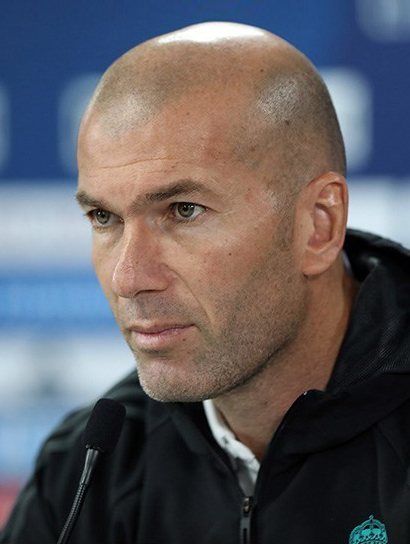
Zinédine Yazid Zidane, affectionately known as 'Zizou', is a towering figure in the history of football, celebrated for his exceptional talent as a central attacking midfielder. Born on June 23, 1972, in Marseille, France, Zidane's career spanned from 1989 to 2006, leaving an indelible mark on both club and international football. His elegance, vision, and technical prowess made him one of the most revered players of his generation. After retiring as a player, Zidane embarked on a managerial career, achieving remarkable success, particularly with Real Madrid.
Position
Zidane primarily operated as an attacking midfielder (position code: M), often playing as a number 10. He excelled in a central role, dictating the tempo of play, creating chances, and scoring crucial goals. His ability to control the midfield, combined with his exceptional dribbling and passing range, allowed him to influence matches from deep or in advanced positions. He was adept at finding space between the opposition's midfield and defense, making him a constant threat.
Identity
Zidane's headline identity is that of a quintessential playmaker. He was a player who combined physical strength with exquisite technical skill, capable of moments of individual brilliance that could turn the tide of a match. His calm demeanor under pressure, coupled with his ability to perform on the biggest stages, solidified his status as a footballing icon. His nickname, 'Zizou', became synonymous with grace and genius on the pitch.
Career path
Zinedine Zidane's professional journey began in France before he achieved global superstardom in Italy and Spain. His progression through various clubs showcased his development from a promising talent into a world-class midfielder.
Cannes
Zidane began his youth career at US Saint-Henri and Septèmes-les-Vallons before joining AS Cannes' academy in 1987. He made his professional debut for Cannes in 1989 at the age of 17. He spent four seasons with the club, making 61 appearances and scoring 6 goals, gaining valuable experience in the French top flight before moving on in 1992 [Transfermarkt].
Bordeaux
In 1992, Zidane transferred to Girondins de Bordeaux, where he spent four successful seasons. It was at Bordeaux that Zidane began to establish himself as a prominent midfielder in European football. He helped Bordeaux reach the final of the UEFA Intertoto Cup in 1995 and the UEFA Cup final in 1996. During his time there, he played 161 matches, scoring 39 goals across all competitions [Transfermarkt].
Juventus
Zidane's move to Juventus in 1996 marked a significant step in his career, elevating him to elite status. He quickly became an integral part of Marcello Lippi's side, winning two Serie A titles in 1996–97 and 1997–98, as well as the UEFA Super Cup and Intercontinental Cup in 1996. He also reached two UEFA Champions League finals with Juventus. Across five seasons, Zidane made 212 appearances for the Turin club, scoring 31 goals [Transfermarkt].
Real Madrid
In 2001, Zidane made a then-world record transfer to Real Madrid, joining their Galácticos era. His tenure at the Santiago Bernabéu is most famously remembered for his iconic left-footed volley in the 2002 UEFA Champions League final against Bayer Leverkusen, securing Real Madrid's ninth European Cup [UEFA.com]. He also won La Liga in the 2002–03 season. Zidane remained at Real Madrid until his retirement in 2006, playing 227 matches and scoring 49 goals [Transfermarkt].
Playing style
Zinedine Zidane's playing style was characterized by a rare blend of elegance, power, and exceptional technical ability. Operating primarily as an attacking midfielder, he possessed a unique capacity to control the flow of a game and unlock defenses with moments of individual brilliance.
One of his most notable attributes was his close ball control and dribbling. Zidane could glide past opponents with effortless ease, often utilizing his signature 'roulette' or 'Marseille turn' to evade markers. This ability to retain possession under pressure and navigate tight spaces made him incredibly difficult to dispossess. His dribbling was not about raw pace but rather about exquisite balance, body feints, and precise footwork.
His passing range was another hallmark of his game. Zidane could deliver pinpoint long balls to switch play, incisive through balls to split defenses, and delicate short passes to maintain possession. His vision allowed him to spot opportunities that others couldn't, consistently finding teammates in advantageous positions. This made him a primary creative outlet for every team he played for.
Beyond his creative talents, Zidane was also a goal-scorer, particularly in crucial matches. While not a prolific striker, his ability to arrive late in the box, strike from distance, and convert penalties added another dimension to his game. The volley in the 2002 Champions League final serves as a prime example of his technical proficiency in front of goal [UEFA.com]. Furthermore, Zidane possessed significant physical strength, allowing him to hold off defenders and win aerial duels, contributing to both offensive and defensive phases. His composure under pressure was legendary, enabling him to execute complex maneuvers and crucial passes in high-stakes situations. His playing style is often compared to other elegant playmakers such as Juan Román Riquelme or Mesut Özil, though Zidane's blend of power and grace was arguably unique.
Achievements & honours
Zinedine Zidane's career was adorned with numerous team and individual accolades, cementing his status as one of football's all-time greats. His impact was felt across both club and international stages, culminating in major trophies and personal recognition.
Club Honours
| Club | Competition | Year(s) |
|---|---|---|
| Juventus | Serie A | 1996–97, 1997–98 |
| Juventus | UEFA Super Cup | 1996 |
| Juventus | Intercontinental Cup | 1996 |
| Real Madrid | UEFA Champions League | 2001–02 |
| Real Madrid | La Liga | 2002–03 |
| Real Madrid | Intercontinental Cup | 2002 |
International Honours
- 1998 FIFA World Cup winner [FIFA.com]
- 2000 UEFA European Championship winner [UEFA.com]
Individual Awards
- 1998 Ballon d'Or [Wikipedia]
- 3× FIFA World Player of the Year (1998, 2000, 2003) [Wikipedia]
- 2006 FIFA World Cup Golden Ball [FIFA.com]
Managerial Achievements
- Real Madrid manager 3× UEFA Champions League (2015–16, 2016–17, 2017–18) [UEFA.com]
International career
Zinedine Zidane's international career with France spanned from 1994 to 2006, during which he earned 108 caps and scored 31 goals. He made his senior debut for France on August 17, 1994, coming on as a substitute and scoring two goals to secure a 2–2 draw against the Czech Republic [FIFA.com].
His most significant contribution to French football came at the 1998 FIFA World Cup, hosted in France. Zidane played a pivotal role throughout the tournament, notably scoring two headers in the final against Brazil, leading France to a historic 3–0 victory and their first-ever World Cup title [FIFA.com]. Two years later, he was instrumental in France's triumph at UEFA Euro 2000, where his performances earned him the Player of the Tournament award as France became the first reigning world champions to win the European Championship [UEFA.com].
Zidane continued to represent France in subsequent major tournaments, including the 2002 FIFA World Cup, UEFA Euro 2004, and the 2006 FIFA World Cup. Despite initially retiring from international football after Euro 2004, he returned to help France qualify for the 2006 World Cup. In what would be his final tournament, Zidane delivered a series of masterful performances, guiding an underdog French side to the final against Italy. He scored an early penalty in the final but was famously sent off in extra time. Despite the red card, his overall contributions earned him the Golden Ball award as the tournament's best player [FIFA.com].
What makes Zinedine Zidane stand out
Zinedine Zidane's ability to stand out stemmed from a harmonious blend of technical brilliance, tactical intelligence, and an innate capacity for performing under immense pressure. His signature 'roulette' move, where he would spin over the ball while shielding it from a defender, became synonymous with his elegant yet effective dribbling style. This move, along with his exceptional first touch and close control, allowed him to navigate congested midfields with ease.
Perhaps his most defining quality was his knack for iconic moments. The volley in the 2002 UEFA Champions League final against Bayer Leverkusen remains one of the greatest goals in the competition's history, showcasing his perfect technique and composure [UEFA.com]. Similarly, his two headed goals in the 1998 World Cup final against Brazil cemented his legacy as a big-game player who delivered when it mattered most. Zidane possessed a unique aura on the pitch, combining physical presence with a balletic grace that made him captivating to watch.
"He is the master. He is the greatest player of his generation." – Pelé