Overview
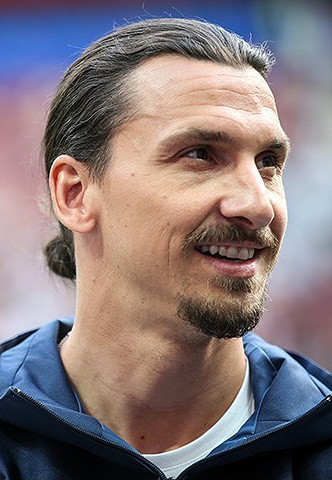
Zlatan Ibrahimović, born on October 3, 1981, in Malmö, Sweden, established himself as one of football's most prolific and charismatic forwards over a career spanning more than two decades. Known for his technical prowess, physical strength, and an often audacious approach to goalscoring, Ibrahimović's career saw him play for some of Europe's most prestigious clubs, accumulating numerous league titles and individual accolades. His imposing 1.95 m (6 ft 5 in) frame combined with exceptional athleticism allowed him to dominate opposition defenders both in the air and on the ground. Despite his height, he possessed remarkable agility and ball control, frequently scoring spectacular goals that defied his physical stature.
Position
Throughout his career, Ibrahimović primarily operated as a central striker or target man. His role often involved leading the attack, holding up play, and bringing teammates into offensive sequences. He was equally adept at dropping deep to link play or exploiting space behind defensive lines. His versatility also allowed him to occasionally drift wide, though his most impactful contributions consistently came from a central attacking position, leveraging his powerful shot and aerial ability.
Identity
Ibrahimović's identity on the pitch was defined by his unique blend of power, technique, and personality. He was a player who consistently delivered in crucial moments, known for his self-belief and ability to perform under pressure. Off the pitch, his outspoken nature and self-assured statements contributed to his iconic status, making him a figure who transcended the sport. His career is marked by a consistent ability to score goals across different leagues and cultures, adapting his game while maintaining his distinctive flair.
Career path
Zlatan Ibrahimović's extensive club career began in his native Sweden before taking him to some of the biggest leagues in Europe, where he collected numerous domestic titles.
Malmö FF (1999–2001)
Ibrahimović began his professional career with Malmö FF in 1999. He made his senior debut in the Allsvenskan and quickly showcased his potential, attracting attention from major European clubs. His performances for Malmö set the stage for his move abroad. Transfermarkt details his departure in July 2001.
Ajax (2001–2004)
In 2001, Ibrahimović joined Dutch giants Ajax for a reported fee of €7.8 million. It was in Amsterdam that he truly began to hone his skills on the European stage, winning two Eredivisie titles and the KNVB Cup. His memorable solo goal against NAC Breda in 2004 remains a highlight of his time there. He departed for Italy in the summer of 2004. Wikipedia provides context on this transfer.
Juventus (2004–2006)
Ibrahimović moved to Juventus in 2004, immediately impacting Serie A. He won two Scudetti with the club, though these were later revoked due to the Calciopoli scandal. His two seasons in Turin solidified his reputation as a top-tier striker.
Inter Milan (2006–2009)
Following Juventus' relegation, Ibrahimović transferred to rivals Inter Milan in 2006. He enjoyed a highly successful spell, winning three consecutive Serie A titles and establishing himself as one of the league's most dominant players. He was the Serie A top scorer in the 2008–09 season.
Barcelona (2009–2010)
A move to Barcelona in 2009 marked a significant chapter, where he won La Liga and the FIFA Club World Cup. Despite a strong goalscoring record, his time at Camp Nou was brief, and he returned to Italy after one season.
AC Milan (2010–2012, 2020–2023)
He joined AC Milan, initially on loan, then permanently, winning another Serie A title in 2011 and the Supercoppa Italiana. After spells elsewhere, he returned to Milan in January 2020, playing a crucial role in their 2021–22 Serie A triumph. He officially retired from professional football in June 2023 at the age of 41. AC Milan's official website confirmed his retirement.
Paris Saint-Germain (2012–2016)
Ibrahimović moved to Paris Saint-Germain in 2012, becoming the face of their ambitious project. He won four consecutive Ligue 1 titles, three Coupes de la Ligue, and two Coupes de France, becoming the club's all-time leading scorer during his tenure, a record he held until surpassed by Edinson Cavani.
Manchester United (2016–2018)
He joined Manchester United in 2016, winning the League Cup and the UEFA Europa League in his first season. Despite suffering a serious knee injury, he returned to play before moving to MLS.
LA Galaxy (2018–2019)
His two seasons with LA Galaxy in Major League Soccer were marked by prolific goalscoring and highlight-reel moments, further cementing his global appeal before his return to AC Milan.
Playing style
Zlatan Ibrahimović's playing style was characterized by a rare combination of physical dominance, exceptional technical skill, and creative flair. Standing at 1.95 m, he was often viewed as a traditional target man, but his game extended far beyond that stereotype. He possessed remarkable agility and coordination for his size, allowing him to execute acrobatic volleys and bicycle kicks with ease, such as his iconic goal against England in 2012. His ability to hold up the ball under pressure was crucial for his teams, providing a focal point for attacks and allowing midfielders to push forward.
Technically, Ibrahimović was ambidextrous, capable of striking powerfully and accurately with both feet, making him unpredictable for defenders. His dribbling, particularly in tight spaces, was surprisingly effective for a player of his stature, often using feints and close control to evade markers. He also demonstrated excellent vision and passing range, frequently dropping deep to orchestrate play and deliver incisive through balls to teammates. His audacious skill moves, often incorporating elements of martial arts due to his background, became a signature part of his game.
His aerial ability was formidable, not just for scoring headers but also for winning flick-ons and contested balls. Ibrahimović's finishing was consistently high-level, converting chances from various angles and distances. According to FBref statistics from his later career, he consistently registered high shot-on-target percentages and non-penalty expected goals (npxG) metrics, indicating his efficiency and dangerous positioning in the box. His leadership and demanding presence also significantly influenced his teammates, often elevating the collective performance of the attacking unit. He could be compared to players like a more technically gifted Jan Koller or a more physically imposing Dennis Bergkamp in terms of his all-round attacking contribution and ability to both score and create.
Achievements & honours
Zlatan Ibrahimović's career is marked by an extensive list of team trophies and individual accolades, primarily from his time in Italy, France, and the Netherlands. He won numerous league titles across four different countries, showcasing his consistent impact at the highest level of European club football.
Club Honours
| Club | Competition | Year(s) |
|---|---|---|
| Ajax | Eredivisie | 2001–02, 2003–04 |
| Ajax | KNVB Cup | 2001–02 |
| Ajax | Johan Cruyff Shield | 2002 |
| Inter Milan | Serie A | 2006–07, 2007–08, 2008–09 |
| Barcelona | La Liga | 2009–10 |
| Barcelona | Supercopa de España | 2009, 2010 |
| Barcelona | UEFA Super Cup | 2009 |
| Barcelona | FIFA Club World Cup | 2009 |
| AC Milan | Serie A | 2010–11, 2021–22 |
| AC Milan | Supercoppa Italiana | 2011 |
| Paris Saint-Germain | Ligue 1 | 2012–13, 2013–14, 2014–15, 2015–16 |
| Paris Saint-Germain | Coupe de France | 2014–15, 2015–16 |
| Paris Saint-Germain | Coupe de la Ligue | 2013–14, 2014–15, 2015–16 |
| Paris Saint-Germain | Trophée des Champions | 2013, 2014, 2015 |
| Manchester United | EFL Cup | 2016–17 |
| Manchester United | FA Community Shield | 2016 |
| Manchester United | UEFA Europa League | 2016–17 |
Individual Awards
Among his significant individual accolades, Ibrahimović won the Guldbollen (Swedish Footballer of the Year) a record 12 times. He was also named Serie A Footballer of the Year three times, Ligue 1 Player of the Year three times, and was included in the FIFA FIFPro World XI in 2013. He won the UEFA Europa League top scorer award in the 2016–17 season. His consistent goalscoring saw him finish as the top scorer in Serie A (2008–09, 2011–12) and Ligue 1 (2012–13, 2013–14, 2015–16) multiple times.
International career
Zlatan Ibrahimović represented the Sweden national team with distinction for over 15 years, becoming their all-time leading goal scorer. He made his senior international debut for Sweden on January 31, 2001, against the Faroe Islands. Over his career, he earned 122 caps and scored 62 goals for his country, a record for a Swedish male footballer. FIFA's records confirm his international statistics.
Ibrahimović participated in several major international tournaments. He featured in the UEFA European Championship in 2004, 2008, 2012, and 2016. He also played a key role in Sweden's qualification for the FIFA World Cup in 2002 and 2006. Despite his prolific club career, a major international trophy with Sweden remained elusive. His role for the national team was consistently that of the primary attacking threat and talisman, often tasked with creating and converting chances against stronger opposition.
He initially retired from international football after Euro 2016 but made a dramatic return to the squad in March 2021 for the 2022 FIFA World Cup qualifiers, demonstrating his enduring commitment to his national side even at an advanced age. Although Sweden ultimately did not qualify for the 2022 World Cup, his return underscored his iconic status and leadership qualities within the team. His presence often elevated the performance of the entire squad, inspiring teammates with his confidence and skill.
What makes Zlatan Ibrahimović stand out
Zlatan Ibrahimović stood out due to a unique confluence of physical attributes, technical genius, and an indomitable personality. His ability to score extraordinary goals, often through acrobatic finishes or powerful strikes from distance, set him apart. He possessed an almost unparalleled self-belief, which translated into audacious plays and clutch performances on the biggest stages. This confidence, combined with his imposing physique and martial arts background, allowed him to dominate defenders and score goals that few others could even attempt.
His versatility in adapting his game across multiple European leagues—from the Eredivisie to Serie A, La Liga, Ligue 1, and the Premier League—and consistently achieving success is another defining trait. He wasn't just a goalscorer but also a significant creative force, capable of intricate link-up play and providing assists. His leadership, both vocal and by example, often transformed the dynamics of the teams he represented, making him a central figure wherever he played.
"I came, I saw, I conquered."